
The Burning Of Atlanta: What Really Happened?
By Stephen Davis · Originally published April 2016 · pp. 18–20
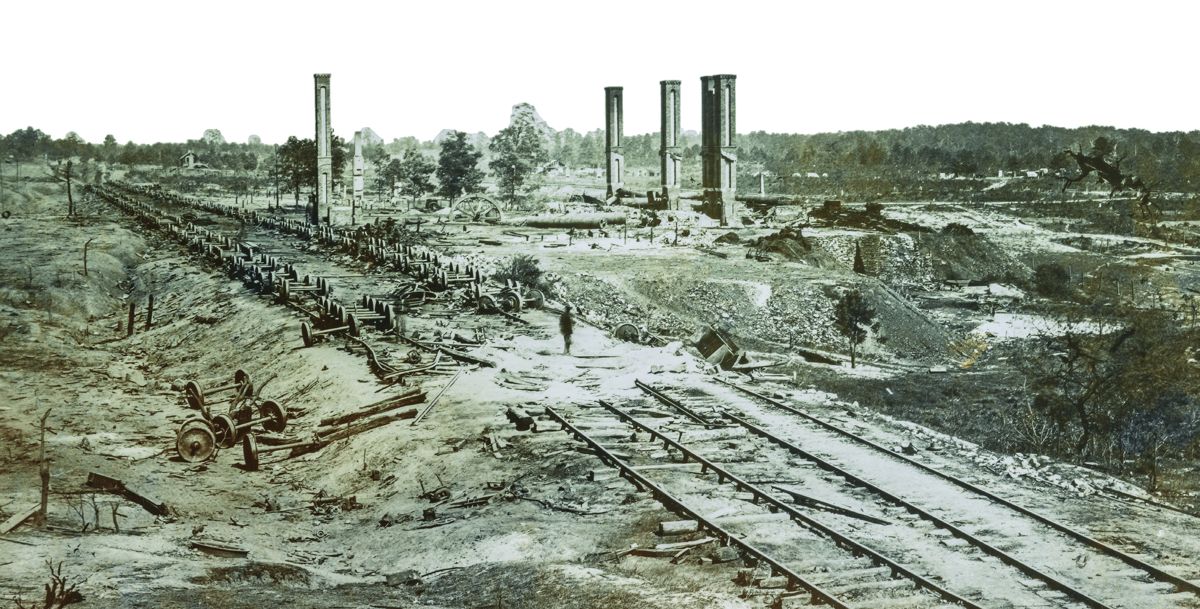
The Burning Of Atlanta: What Really Happened? By Stephen Davis Big fires in American history spawn legends. Mrs. O’Leary‘s cow may not have started the Great Chicago Fire, but William T. Sherman’s shadow looms large over the Burning of Atlanta. The old legend has it that he allowed his soldiers to burn the entire city. Go to the Georgia state capitol today and you’ll see on the square a plaque placed there in 1920 by the United Daughters of the Confederacy. On September 2, it states, Federal troops entered Atlanta and shortly thereafter Sherman “reduced the city to ashes.”1 It really didn’t happen that way, but after almost a century the plaque is still there. Old legends die hard. The truth—or as near to it as we can get—is more complicated—and fascinating.
General Sherman had only been in Atlanta a few days when he proposed to U. S. Grant an idea for his next campaign: rest his troops at Atlanta for a while, then march them across Georgia to Savannah and the Atlantic Ocean. “I would not hesitate to cross the State of Georgia with sixty thousand men,” he wrote on September 10, 1864. Later he added, “I can make the march and make Georgia howl.”2 Of course, before he left for the sea, Sherman would have to tend to the enemy facing him. At the time, Gen. John B. Hood’s Army of Tennessee, having evacuated Atlanta, was hovering twenty miles south of it. In late September Hood decided to march off into north Georgia, either hoping to lure the Federals into battle or striking the Chattanooga-Atlanta railroad to cut them off from supplies. Sherman eventually sent George Thomas and John Schofield with two infantry corps back to Tennessee, where Hood seemed to be heading. Then, in early October, Sherman slowly followed Hood’s course with three corps, leaving Gen. Henry Slocum’s XX Corps to hold Atlanta. By October 11, Grant had approved Sherman’s proposed march to the sea. Sherman would have to wait awhile, though, before launching it. For the next month he tarried in north Georgia with his XIV, XV and XVII Corps, monitoring the movements of the Rebel army. Meanwhile he got his commissary and quartermaster officers in Atlanta gathering supplies and getting rid of the stuff his troops would not need for “the grand move into Georgia,” “my big raid,” and “the grand march,” as he variously called it. On November 1 he also ordered Slocum to “make preliminary preparations for the absolute destruction in Atlanta of the railroad track, depots, car and store houses, shops, and indeed everything that might be used to our disadvantage by an enemy.” It is likely that General Sherman had more than that in mind for the city he had worked so hard to capture. To Grant on November 6 he confided that before he left, he would see that “Atlanta itself is utterly destroyed.”3 The people themselves had all been cleared out. Soon after taking Atlanta Sherman ordered all remaining civilians to leave. They could go south; he arranged a ten-day truce with Hood so those wishing to enter Confederate lines could do so. Or they could go north; he offered train transport to Nashville, Louisville and other points. By late September almost all civilians had been expelled. After that, the story of Sherman’s wrecking of Atlanta begins with three Federal regiments. During most of the occupation, only three
Union regiments—the 2nd and 33rd Massachusetts and 111th Pennsylvania—were quartered downtown. The rest of Slocum’s troops were encamped outside of the city. To these three regiments was assigned the work of planning the destruction of Atlanta’s railroad and manufacturing facilities. The 2nd got the big passenger depot (the “car shed”) in the center of the city, and factory buildings to its east along Decatur Street. The 111th would destroy the Western & Atlantic roundhouse and the gas works out Marietta Street. The 33rd would target the Macon & Western roundhouse, but also the several blocks of commercial storefront along Whitehall and Peachtree Streets. On a map submitted to Col. William Cogswell, post commandant, an officer of the 33rd shaded in an area labeled simply “brick block.” But also to be destroyed were downtown hotels and even the Medical College, where sick Federal soldiers were being treated. The only explanation for destroying such non-military targets was that orders had come down for everything made of brick to be demolished. As one Federal recorded, “it was argued that the rebels could use the large buildings for hospitals, warehouses and so forth.”4 So everything brick would come down. Notice that Atlanta’s houses and private residences were not on the Federals’ list of structures to be burned. That did not mean that General Sherman did not expect his soldiers to spare people’s homes. Earlier in the year, Sherman had led 26,000 troops from Vicksburg eastward across Mississippi to Meridian. At Jackson, Brandon and other places, Union soldiers had burned both public facilities and private homes. Even after Gen. James B. McPherson ordered no burning of citizens’ houses, soldiers set fire to them. “There was a growing sense among Sherman’s men,” writes historian Clay Mountcastle, “that their destructive behavior would largely go unpunished and was perhaps even welcomed by the officers.”5 This was indeed the attitude among the men when Sherman was about to lead his three corps from northwest Georgia back to Atlanta. Before leaving Rome, Gen. John Corse’s division was ordered to destroy railroad shops and foundries, but the soldiers set fire to houses, too. Much of Rome thus went up in flames. “It is against orders,” wrote one Federal on November 10, “but the soldiers want to see it burn.” Orders could vary, and at points Union officers were told to burn houses and whole towns if guerrillas were active in the area. Gen. John Smith, division commander in the XV Corps, directed a regiment at Canton to “permit the citizens to remove what they desire, and burn the town.” Cassville was also torched. One lady remembered years later how a Yankee officer came up and said, “”Madame, I have orders to burn your house. You have twenty minutes to get your furniture out.”6 Before he got back to Atlanta, Sherman changed his mind on who would do the wrecking of the designated structures. The plans submitted by the three provost regiments stressed fire and explosives, but trained engineers knew how to knock down buildings more efficiently. Sherman on November 7 thus ordered his chief engineer, Capt. Orlando Poe, to take on the work of demolition in Atlanta. A few days later Sherman gave to go-ahead to Poe: “You may commence the work of destruction at once, but don’t use fire until the last moment.” One probable reason for this delayed— fire order involved Sherman’s infantry. As Poe’s engineers went to work, the XIV, XV and XVII Corps would be marching back into and through Atlanta to positions east and south of the city, preparatory to beginning the big campaign. Sherman could not have them marching through a city on fire.7 On the morning of November 12 the last northbound train left Atlanta, carrying the last equipment and stores not needed in the forthcoming campaign. After the train crossed the Etowah River thirty miles north of the city, Federals moving south along the railroad began tearing up track. Inside Atlanta regiments were assigned to pry up the rails, heat them on burning ties, and twist them beyond repair. On the 13th engineers brought down the Western & Atlantic bridge over the Chattahoochee, which Northerners had rebuilt on wooden beams months earlier, after the Rebels had destroyed it in their retreat. The next morning, obeying Sherman’s orders not to use fire till the last, Poe’s engineers used iron battering rams on tall sawhorses to knock down the brick car shed. The Macon & Western freight depot, built of granite, was too sturdy to be knocked down; the 1st Michigan Engineers blew it up with 700 pounds of powder. All was not orderly, however. For days word had spread among Slocum’s men that Atlanta was going to be torched. A Wisconsin private wrote his wife on November 7 that they would “burn up the Gate City.” “Old Sherman,” wrote another, “is cleaning Atlanta and is going to burn the place.”8 Sensing that they were within days of setting out for the sea, some soldiers took matters in their own hands and set unauthorized fires to houses along Decatur Street on the night of the 11th. Fire wagons about to be put on the train heading north were called into action, and guards were ordered to “shoot on the spot all incendiaries.” General Slocum posted a $500 reward to any informant, but nobody snitched. Despite all the precautions, somebody set another blaze on the 12th. “Large fire in the City again to day,” recorded Isaac Roseberry, a Michigan engineer, in his diary.9 It was even worse the next day. On November 13 engineers and pioneer regiments began setting fire to designated facilities. “Of course the fires have spread considerably among the residences,” observed
All of this was burned. Sherman’s intent to see Atlanta “utterly destroyed” called for the burning of the downtown business area. This view by Barnard looks north along Whitehall Street. Across the railroad is the Georgia Railroad Bank, which was set ablaze in the fires of November 15. A year after the war Barnard revisited Atlanta; the bank, a burned-out shell, had not been rebuilt. (Library of Congress)
Some buildings were targeted, others were not. Across the tracks are the Atlanta Hotel and the Trout House hotel. Both were designated for demolition, as Sherman called for the leveling of brick buildings downtown. There were exceptions. The Masonic Hall, to the right of the Atlanta Hotel, was not damaged. Barnard took this view in the last days of the occupation. On the loading platform across the tracks is a fire engine which was to be loaded on a northbound train. When the first fires broke out on November 11, soldiers put it back to work. To the far right, on the wall of the Atlanta Intelligencer building, is a handbill for “Wentworth’s the New American Hercules Tonight Nov. 8.”
(Library of Congress) Capt. Edwin E. Marvin of the 5th Connecticut. Soldiers marching in could see all the fires being set and determined to start some of their own. Eleven-year-old Carrie Berry and her family were among the few civilians allowed by authorities to remain in the city. “Sun. Nov. 13,” she entered in her diary; “the federal soldiers have ben coming to day and burning houses.”10 The men were right about their officers looking the other way. The 13th was the day Sherman and his staff rode into Marietta, and saw men set fires to the courthouse, hotel and stores on the town square. According to the general’s aide-de-camp, Maj. Ward Nichols, “stragglers will get into these places, and dwelling-houses are leveled to the ground.” Another officer, Maj. Henry Hitchcock, expressed concern at the men’s misdeeds, to which Sherman replied, “I never ordered burning of any dwelling—didn’t order this, but can’t be helped.”11
On the 14th, having knocked down the car shed and other buildings, Federals set fire to the wreckage. The infantry saw all this, and concluded (as one put it), that “the pioneers were having all the fun.” So they set their own blazes. Allen Campbell, a sergeant in the 1st Michigan Engineers, knew very well the orders against unauthorized arson, but he didn’t care. With torch in hand he approached a residence, only to be stopped by a little girl. “Mr. Soldier, you would not burn our house, would you?” she asked. “If you do, where are we going to live?”12 Campbell felt so ashamed that he skulked away, leaving the little girl’s home unharmed. The engineers conducted their final detonations on the morning of November 15. This was the day that the “brick block” along Whitehall and Peachtree Streets was set afire, as were the downtown hotels which had been marked for destruction.
especially after commissary officers opened their warehouses and soldiers found liquor inside. “The men plunged into the houses, broke windows and doors with their muskets,” Capt. David Conyngham recorded. Drunken looters pillaged, “dragging out armfuls of clothes, tobacco and whiskey, which was more welcome than all the rest.” The burning of both businesses and residences reached its hellish crescendo that day. “Many houses had been burned,” recorded Dr. E.P. Burton of the 7th Illinois in his diary, “and all day long the fires kept increasing in number.” The infantry marching into town along Marietta Street continued to do their part. “We arrived in the suburbs of Atlanta at 2 p.m.,” wrote Capt. James R. Ladd of the 113th Ohio. “No sooner did we arrive than the boys commenced burning every house in that part of the town.”13 The unauthorized arson continued well after sunset. Carrie Berry and her family sat up all night in their home on Fairlie Street. “If we had not sat up our house would have ben burnt up,” she entered into her diary the next day; “the soldiers were going around setting houses on fire where they were not watched.”14 In truth, areas of downtown were under guard by Colonel Cogswell’s provost regiments. Capt. Henry Comey of the 2nd Massachusetts later wrote that the men of his regiment stood their posts while all the burning was going on, under orders “to guard all other structures, houses and churches from those who would torch such private property.”15 (The Berry family was fortunate to have a guard standing at their house.) On the night of November 15, Major Hitchcock was with Sherman at his headquarters in the John Neal house, across the street from City Hall. At some point he chose to take a walk to the car shed, a few blocks away. Coming back, guards at two downtown churches nudged him into the street; they would not let him pass on the sidewalk. This brings up the local legend of Father O’Reilly. Thomas O’Reilly was priest of Immaculate Conception Cathedral downtown. He was one of those civilians allowed to stay in the city after the expulsion. A half-century ago the Atlanta Historical Society dedicated a monument to Father O’Reilly, thanking him for saving City Hall and five nearby churches, including Immaculate Conception, from being burned by Union sol-
diers on the night of November 15. A local newspaper article about the monument dedication was entitled, “Monument to Priest Who Stood Up to Sherman,” as if the Union commander had ordered the downtown church-burnings.16 But how did the good Father “save” the churches? The story has several variants. An early one is that on the night of the great fires, Catholic soldiers voluntarily stood guard at the cathedral and parsonage, “and would not allow any homes adjacent to be fired that would endanger them.”17 Thus the nearby City Hall and Protestant churches were saved. Never mind that one of the provost regiments keeping order in the city, the 2nd Massachusetts, had its camp on the very grounds of City Hall square, or that General Sherman’s very headquarters were right across the street. Another spin comes from Union Captain Conyngham, who wrote in 1865 that “ruffians” – he could not call them fellow Federal soldiers— were running amok downtown, threatening the cathedral, when Father O’Reilly confronted them, and “upbraided them for their sacrilege.” The Yankees “shrank before virtue and truth,” slinking away in shame. Thus Fr. O’Reilly “not only saved his own church, but also those of his fellow Christians.”18 Another version has the priest counseling Sherman. “General Sherman conferred with the Rev. Father Thomas O’Reilly,” according to the Atlanta Journal, “and consented to spare five churches.”19 Still another has O’Reilly meeting not with Sherman, but the XX Corps commander—he “lobbied General Slocum,” according to another local writer, to have guards posted at the churches.20 Wilder versions have O’Reilly a) threatening Slocum that “he had the authority to send all the Catholic soldiers home” if the churches were harmed 21; and b) lecturing Sherman that he could have offending Catholic soldiers excommunicated; whereupon “the red-haired general….mercifully withdrew his orders and the churches of Atlanta were spared.”22 Amidst all of these urban legends, as I call them, the historian has to sort out the facts: how much of Atlanta was destroyed? The Yankees, of course, low-ball their estimates: Major Hitchcock, 25%, Captain Poe, 37%. How they came up with these numbers is anybody’s guess, especially as both officers left Atlanta the very morning after the great fires of November 15, when Sherman set
Tearing up track downtown. The last northbound train left Atlanta on the morning of November 12. After its departure, Federals began tearing up all track in the city, as well as on the Western & Atlantic line from the city to the Etowah River, more than forty miles of railway. Capt. Orlando Poe’s engineers supervised the destruction in the city, but the work was done by regiments of a “Provisional Brigade.” The men shown here prying up the rails are probably of the 66th Ohio, which was assigned to this section of track. The Western & Atlantic freight warehouse is in the background; it stood about three blocks northwest of the Car Shed. The depot was destroyed before the Federals left the city. (Library of Congress) out on his march. Southerners just as naturally tend to exaggerate. A Georgia militia officer, William P. Howard, surveying the city a few weeks later, claimed that anywhere from 3,200 to 4,000, maybe as many as 5,000 houses had been laid waste. “The suburbs present to the eye one vast, naked, ruined, deserted camp,” Howard asserted.23 Ironically, Atlantans returning to their city estimated the destruction rather conservatively. Zachariah Rice, for instance, wrote a column for the Montgomery Appeal, offering his observation of the property damage. Noting destruction of the business district along Whitehall and Peachtree Streets, Rice also emphasized the burning of buildings along main thoroughfares which would have been used by the Yankees marching into the city (Marietta Street) and out of it (Decatur). Of note, Rice confirmed that “the churches are all unhurt,” except for a small chapel in the northern suburbs and St. Luke’s Episcopal downtown—the latter, established by Confederate chaplain Charles Quintard in April ‘64, was called “the Rebel church” by the Federals, and seems to have been deliberately targeted for burning by them.24 Rice’s and some other contemporary accounts have allowed Dr. Gordon Jones of the Atlanta History Center, writing text for a historical marker sponsored by the Georgia Historical Society, to state that “only forty percent of Atlanta was left in ruins.”25 To me, that sounds about right. One GHS marker that doesn’t get it right, though, is one which was dedicated in November 2014 on the grounds of the Carter Center in Atlanta. Its text seems to go out of its way to show that the Federals didn’t burn houses in Atlanta—“destroying Atlanta’s industrial and business (but not residential) districts,” as it reads.26 Someone complained to President Carter about the obvious inaccuracy. At the President’s request the Historical Society has removed the offending plaque to another site. One hundred-fifty years after Sherman’s burning, and we’re still arguing about it! Somewhere ol’ Cump has got to be chuckling over his legacy in Atlanta!
“THE EVACUATION OF ATLANTA….ERECTED BY THE ATLANTA CHAPTER UNITED DAUGHTERS OF THE CONFEDERACY. 1920,” Washington Street entrance, State Capitol. Stephen Davis, What the Yankees Did to Us: Sherman’s Bombardment and Wrecking of Atlanta (Macon, 2012), 360. Davis, What the Yankees Did to Us, 360-62. Davis, What the Yankees Did to Us, 370-72. Clay Mountcastle, Punitive War: Confederate Guerrillas and Union Reprisals (Lawrence KS, 2009), 87-88. What the Yankees Did to Us, 373, 379-80. Ibid., 372-73, 378.
Ibid., 367. Ibid., 373, 390. Ibid., 390-91. Ibid., 381-82; M. A. DeWolfe Howe, ed., Marching with Sherman: Passages from the Letters and Campaign Diaries of Henry Hitchcock (Lincoln NE, 1995 [1927]), 52-53. What the Yankees Did to Us, 389, 395. Ibid., 393-95. Ibid., 404. Ibid., 398. Atlanta Journal, Oct. 19, 1945, p. 29. “Atlanta As left by the Enemy. Report of Gen. Howard,” Macon Telegraph, Dec. 10, 1864. David P. Conyngham, Sherman’s March Through the South (New York, 1865), 238. Laura McGregor, “Trinity Methodist Spared by Sherman,” Atlanta Journal, Aug. 17, 1957. Russell S. Bonds, War Like the Thunderbolt: The Battle and Burning of Atlanta (Yardley PA, 2009), 353. John Wesley Brinsfield, Jr., The Spirit Divided: Memoirs of Civil War Chaplains (Macon, 2006), 225. Doc Lawrence, “Ireland’s Gift to Atlanta—Father Thomas O’Reilly,” Brookhaven Buzz, March 1996, 14. Franklin M. Garrett, Atlanta and Environs: A Chronicle of Its People and Events, 2 vols. (New York, 1954), vol. 1, 654. Davis, What the Yankees Did to Us, 405. “The Burning and Destruction of Atlanta,” Georgia Historical Society marker, originally dedicated at Martin Luther King Jr. Drive and Central Avenue; recently moved to front of Georgia Railroad depot. Alan Blinder, “150 Years Later, Wrestling With a Revised View of Sherman’s March,” New York Times, Nov. 15, 2014.
Stephen Davis is a longtime Civil Warrior and avid book collector. His two paperbacks on the Atlanta Campaign, A Long and Bloody Task and All the Fighting They Want, will be published this summer as part of Savas Beatie’s Emerging Civil War Series.