
Guns Of The CSS Pee Dee Recovered From River
By William Lockridge · Originally published April 2016 · pp. 16–17
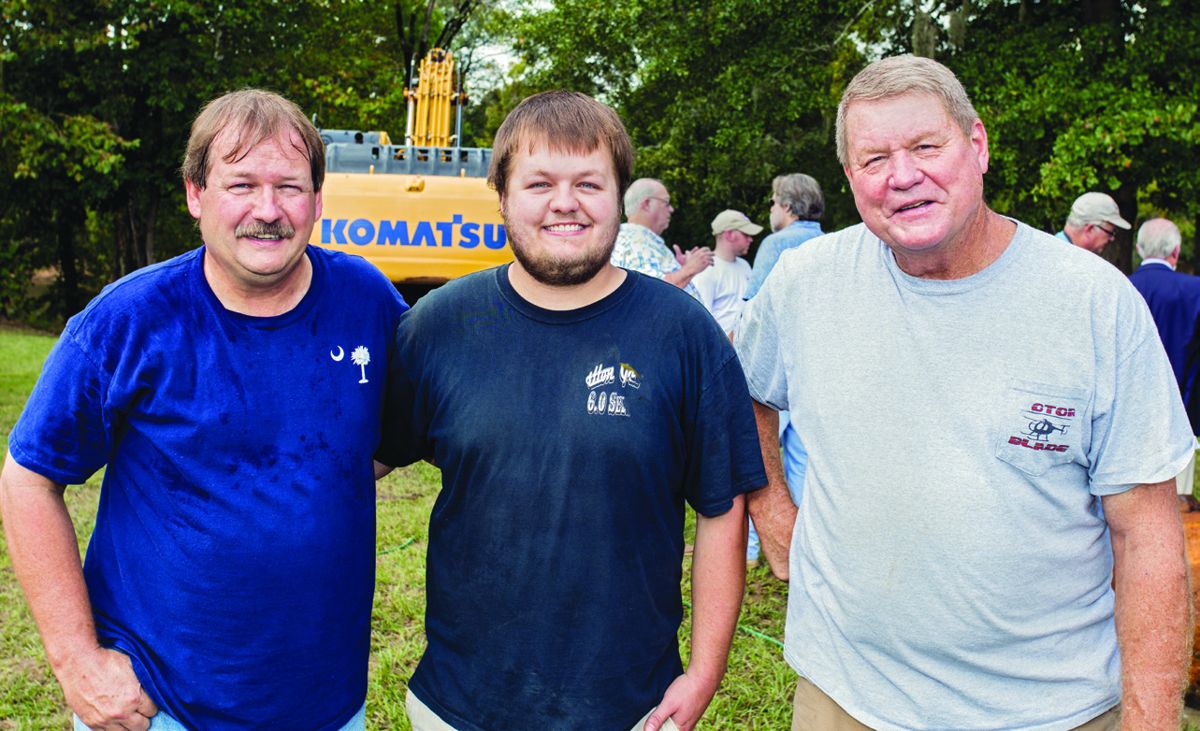
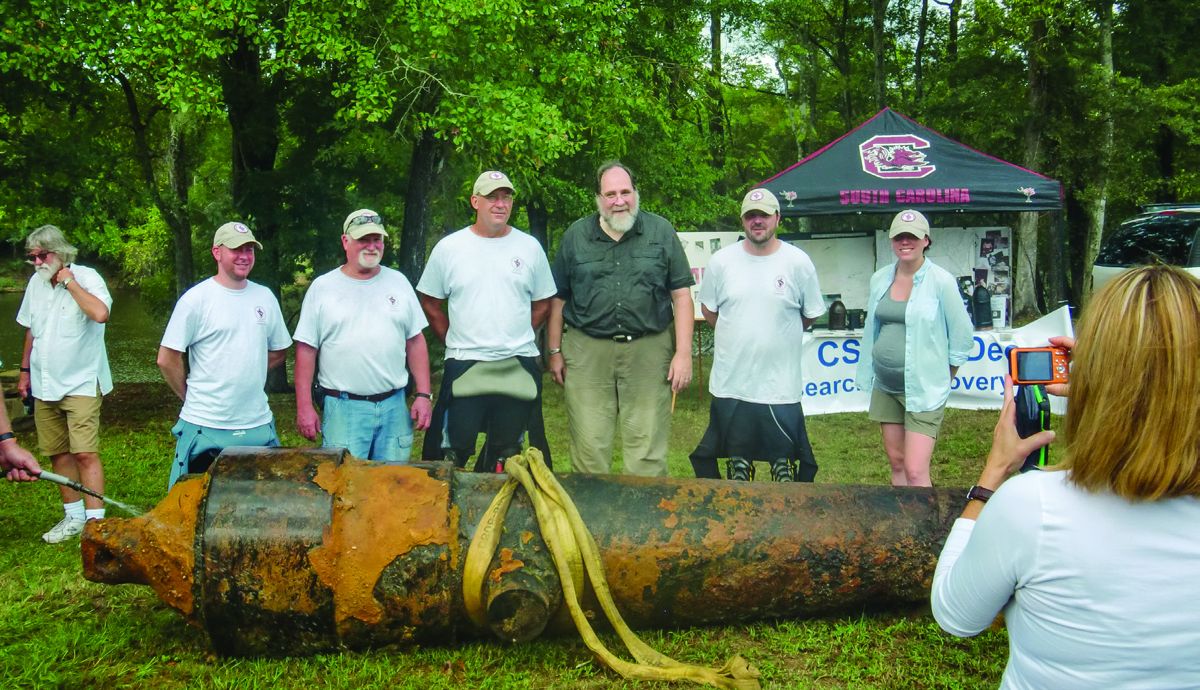
Guns Of The CSS Pee Dee Recovered From River By William Lockridge On Tuesday morning the 29th of September the hopes and dreams of many people were fulfilled when three large cannon tubes long lost in the Pee Dee River were removed from that waterway. Those gathered there on that day included historians and dignitaries of all persuasions. Concerns for site security and limited space prompted the site owners and state officials to undertake the recovery on an “invitation only” basis. Security was evident and effective throughout the property for the duration. The invitees began to gather early with an eye on an uncertain weather outlook. A damp and drizzly dawn yielded to a brighter day and by late morning a hot sun and high humidity left little doubt as to what conditions would be like by the 10 am time set for the recovery of the first tube. Ultimately the mosquitoes, fire ants and smothering weather nearly won that skirmish. One can only imagine what life was like over 150 years ago when there was no relief to look forward to by anyone present there. This story begins in the early years of the War of Northern Aggression when various Confederate naval officers were directed by CSN Secretary Stephen R. Mallory to seek out and develop sites suitable for the construction of vessels to be used by the new nations’ navy. For me, my good friend Catesby ap C. Jones and my son, Parker, the story begins about 7 years ago when a friend introduced me to the current owners of the Mars Bluff Confederate Navy Shipyard (also called the “Pee Dee Shipyard” by some). Some years ago Glenn Dutton and Rufus Perdue had found that the site of the old shipyard property was available and shortly thereafter negotiated its purchase. It was their kindness, hospitality and interest in preserving history that brought so many together on such an uncom- (Jack Melton)
fortable Tuesday morning in late September. During the war Mars Bluff became one of many sites that produced vessels intended for use by the fledgling Navy. Ironically, many shipyards like those in Mars Bluff, South Carolina, Columbus, Georgia, and Montgomery, Selma & Oven Bluff in Alabama were eventually lost to yankee land forces versus those of the Union Navy. The story of the “Guns of the CSS Pee Dee” begins in late fall 1862 when representatives were directed by Secretary Mallory to identify sites suitable for such purposes. The requirements for a navy yard were relatively few. First, there had to be reasonable access down the river leading to the Waccamaw River and other waters of coastal South Carolina. Second, there had to be a good supply of timber suitable for the construction of ships e.g. pine, cypress, oak, etc. Third, there had to be a sufficient supply of labor available to meet the needs of a shipyard, and lastly there needed to be sufficient infrastructure (land, rail, roadways, communications, mail, etc.) to facilitate the work anticipated. Flag Officer D.N. Ingraham, the CSN commander at Charleston, ordered Lt. Alphonse Barbot to undertake the task of identifying suitable sites along the rivers of South Carolina. The land at Mars Bluff itself was owned by Joseph Bird. Bird was more than willing to lease the property to the navy and shortly thereafter negotiated an agreement for the use of the site and some existing improvements thereon. By April 1863, the new shipyard had progressed to the point where actual construction of vessels could begin and the building of the ship to be named the CSS Pee Dee commenced.
CSS Pee Dee Commissioned
The gunboat was designed by Acting Naval Constructor John L.
Porter, CSN, in 1862 from a design originated by Matthew. F. Maury. Lt. Edward J. Means, second commander of the naval yard, supervised initial construction. Lt. Van Rensellaer Morgan superseded Means and it was during his tenure as the third commander of the shipyard that the new gunboat was fitted out and placed into service. The new vessel was placed under the command of Lt. Oscar F. Johnston. Ultimately the gunboat never ventured far from the place of her creation. From her commissioning in April up to the end of her service life the CSS Pee Dee was more of an exercise in “doing something” rather than “fighting” anything. Never challenged nor even exchanging fire with anything representing the Union she spent most of her time in construction and service fighting seasonal discomforts, insects and boredom. It seems that very little has changed since the war regarding personal comforts. However, the boredom issue was nowhere present on the 29th of September past judging by the reception given the guns as each was lifted from the muddy waters of the Pee Dee River! The gunboat now known as the CSS Pee Dee was to be 150 feet in length, have a beam of 25 feet, and draw about 9 feet of water when loaded according to some early accounts. Built primarily for use in shallow coastal waters her accommodations were sparse for the crew of approximately 91 men. Like those serving on so many of the vessels of the new gray nation’s navy, much of their time would likely have been spent ashore in quarters more practicable to their needs.
Gunboat Armed & Provisioned
Eventually the initial plan for arming the boat was superseded by one that called for a much upgraded armament package employing a pair of John M. Brooke-designed double banded rifles made at the Confederate Naval Gun Foundry and Ordnance Works in Selma, Ala. These two rifles comprising VI.4inch (a/k/a 6.4-inch) No. S-53 and 7-inch No. S-46 were capable of accurately firing projectiles well over
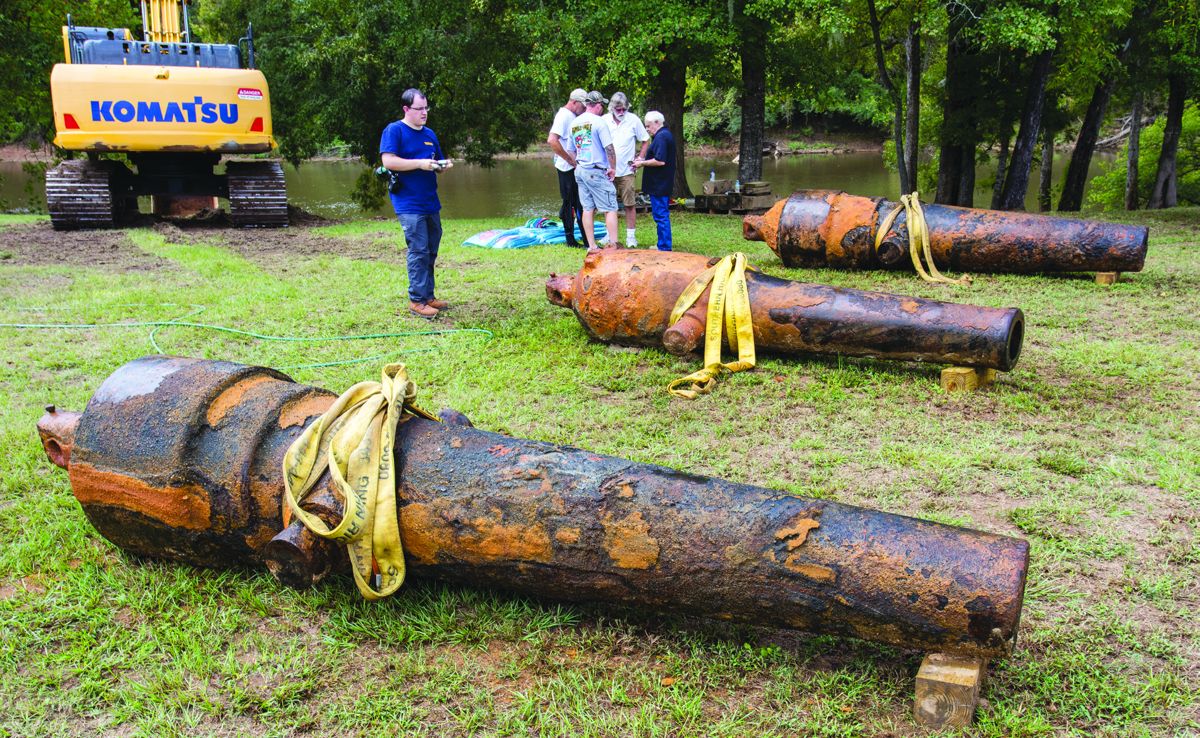
(Jack Melton) 4 miles. The flat nosed cylindrical bolts also designed by Brooke late in 1861 were capable of penetrating over 8-inches of iron plating making them exceptionally dangerous for any opposing ironclads. These two superb rifles were complimented by a 9-inch smoothbore Dahlgren shell gun that had been in service onboard the defeated union ship USS Southfield. The latter tube is number “FP No. 513” produced at the Fort Pitt Foundry at Pittsburg, Pennsylvania in mid-1862. The USS Southfield had been lost on April 19, 1864, during an engagement with the Confederate ram CSS Albemarle near Plymouth, N.C. (see article by Drs. Larry Babits & Lynn Harris together with Joe Beatty (of SCIAA), The Artilleryman magazine, Winter 2015 Vol. 37, No. 1, P. 14). The ever resourceful and weapons hungry Confederates quickly re-purposed the lost union gun. Eventually, these three large guns were placed on deck mounted pivots aboard the gunboat. Carriages for them were constructed at the Charlotte Navy Yard. The 7-inch rifle was situated as the forward deck pivot gun and would have been the gunboat’s primary weapon. The 9-inch Dahlgren shell gun was placed amidships while the VI.4inch Brooke rifle was positioned as the rear pivot gun. These three large naval guns were supplemented by one of several 24-pounder Dahlgren deck howitzers captured by CSA
General Wirt Adams on a union gunboat near Yazoo City, Mississippi in early 1864. Ammunition for the Brooke guns likely came from several sources but most notably the Richmond Naval Ordnance Works and fabricated under the supervision of Lt. Robert D. Minor (see article by Jack W. Melton, Jr. in The Artilleryman magazine, Winter 2015, Vol. 37, No. 1, P. 47). The ammunition for the 9-inch Dahlgren would most likely have been taken from the stores of the USS Southfield at the same time the guns were removed or elsewhere manufactured by a CS Ordnance facility. As for her “war record”, the CSS Pee Dee made one brief sortie upriver during the last week of February 1865 to a point near the large Confederate depot at Cheraw, S.C. The purpose was to support CSA General Hardee in defending that city against the invading troops of General William Sherman. Faced with the 10,000 or so men in Sherman’s command, Hardee prudently ordered a fast and full retreat. Hardee’s parting orders to Johnston were to return to the shipyard and to destroy the CSS Pee Dee along with any other boats, the shipyard and the nearby railroad ridge. Means destroyed much of the shipyard along with the several other vessels also building there but did not destroy the railway bridge knowing it would be needed by the local population as soon as the yankee troops passed on.
Upon return to the shipyard after the Cheraw adventure the gunboat had been grounded by falling water with the stern near mid-stream and the bow near the river’s bank. In order to free the gunboat it had to be off-loaded. To accomplish this, the guns, ammunition and other stores were thrown overboard. The gunboat was then maneuvered downstream below the railroad bridge and there burned to the waterline. That the destruction of the boat was undertaken per the orders of Hardee must have offered little solace to those who had labored so hard to bring her to life.
Current Recovery Process
The most recent efforts leading to the recovery of the gun tubes began in 2009 and involved SCIAA, East Carolina University Program in Maritime Studies (ECU), and Francis Marion University (FMU) Conservation facility with project funding from The Drs. Bruce and Lee Foundation of nearby Florence. These efforts have been led by and significantly contributed to by Dr. John Leader, State Archaeologist, Dr. Chris Amer as former Head of the MRD, his successor, Dr. James Spirek, Dr. Larry Babits, Director of the Program in Maritime Studies at Eastern Carolina University (now retired) together with Dr. Lynn Harris, Assistant Professor, ECU as Co-Principal Investigators during the 2009 Field School, and a number of university students representing ECU and FMU. Shipyard property owners Dutton and Perdue have also contributed substantially to this work ably assisted by Dutton’s son, Tanner.
Retrieval of Guns & Plans
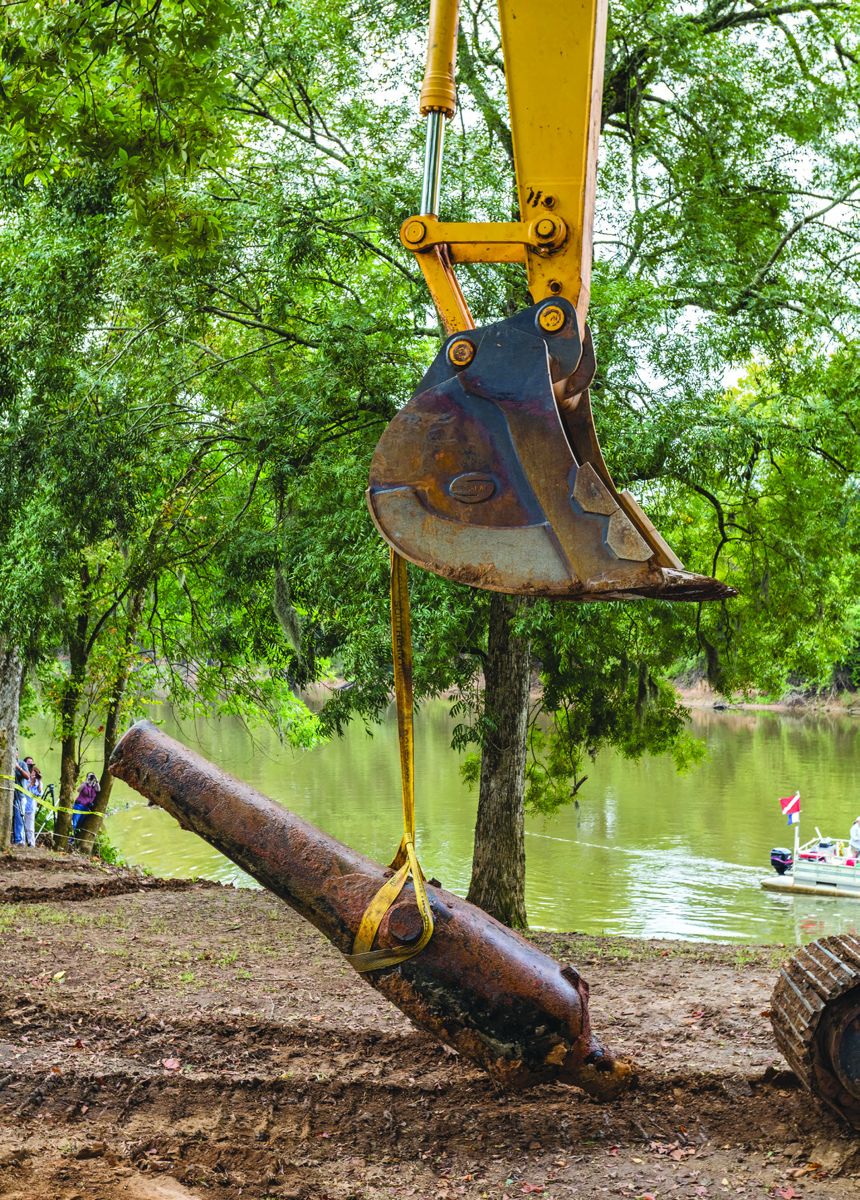
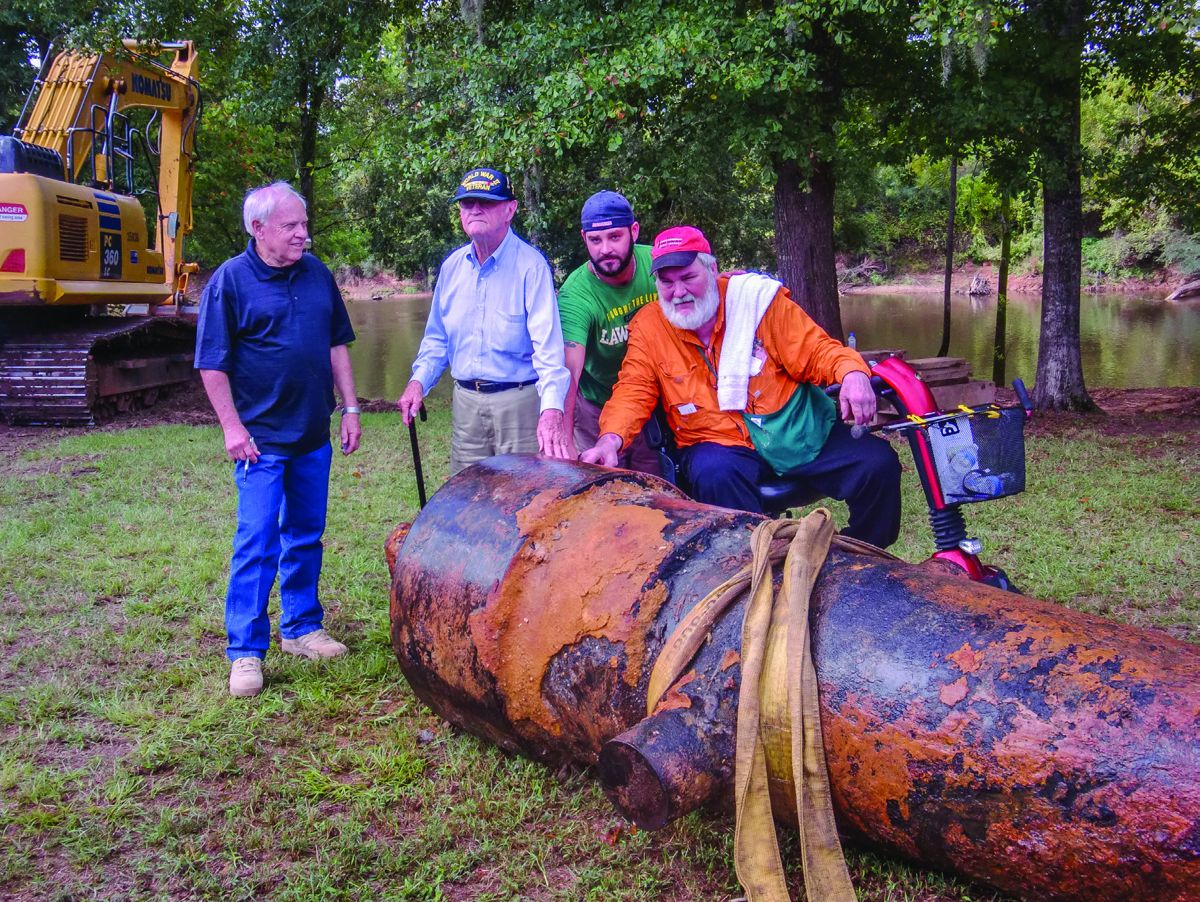
After many years, the time finally arrived for recovery of the most sought after artifacts of the CSS Pee Dee. Notice came from SCIAA that the guns would be removed from the river on the morning of Tuesday, September 29th, 2015. Among those invited dignitaries and guests was the great grandson of CSN Commander Catesby ap R. Jones. He is Mr. Catesby ap Catesby Jones (90 years) of Selma, Ala. He is also one of only two individuals living who have physically touched each and every one of the known 18 surviving Selma-made Brooke guns thus far recovered. At 10 am the retrieval process began when Dutton positioned a track hoe on the bank adjacent to the location of Brooke Tube No. 53. The lifting straps were attached to a pre-fitted harness and the tube was raised from a long immersion to dry ground after 150 plus years. Handled with great care the giant gun tube was expertly lowered onto the ground and then positioned on cribbing pending preparation for transport to the Warren Lasch Conservation Center on Wednesday. Quickly after this the 9-inch Dahlgren gun and the 7-inch Brooke rifle were expertly hoisted onto the grounds of the old shipyard. In less than an hour all three recoveries had been accomplished – work that had been so anxiously awaited by so many for so long. The guns were kept wet until the news media and others present had the opportunity to view these historic tubes so long missing a human presence. By about 1 pm the process of preparing the tubes for transport had begun and most of the guests had departed. At long last the lost guns of the CSS Pee Dee were back on dry ground. The tubes would not rest there for long, however. All three tubes were moved to the Warren Lasch Conservation Center in North Charleston, SC on Wednesday September 30 to undergo conservation. Following the restorative work the guns will be placed on public display in Florence at the new Veterans Administration facility there. William E. Lockridge is the author of a book detailing the role of Selma, Alabama during the war of 1861-1865. His research has been underway for over 10 years and represents the most detailed study thus far undertaken on that place during the war. That research has included a very detailed examination of the Selma/Confederate Naval Gun Foundry & Ordnance Works and the story behind the production of the best large cannon produced anywhere in the world at the time – the double banded Brooke guns which are so much a part of the story of the CSS Pee Dee. He has touched each of the 18 surviving Selma gun tubes (along with Catesby ap C. Jones) during his field work.