
Center Shot: Private Jacob Miller Of The 9th Indiana Vol. Infantry
By Michael Lee Kelley · Originally published April 2016 · pp. 6–7
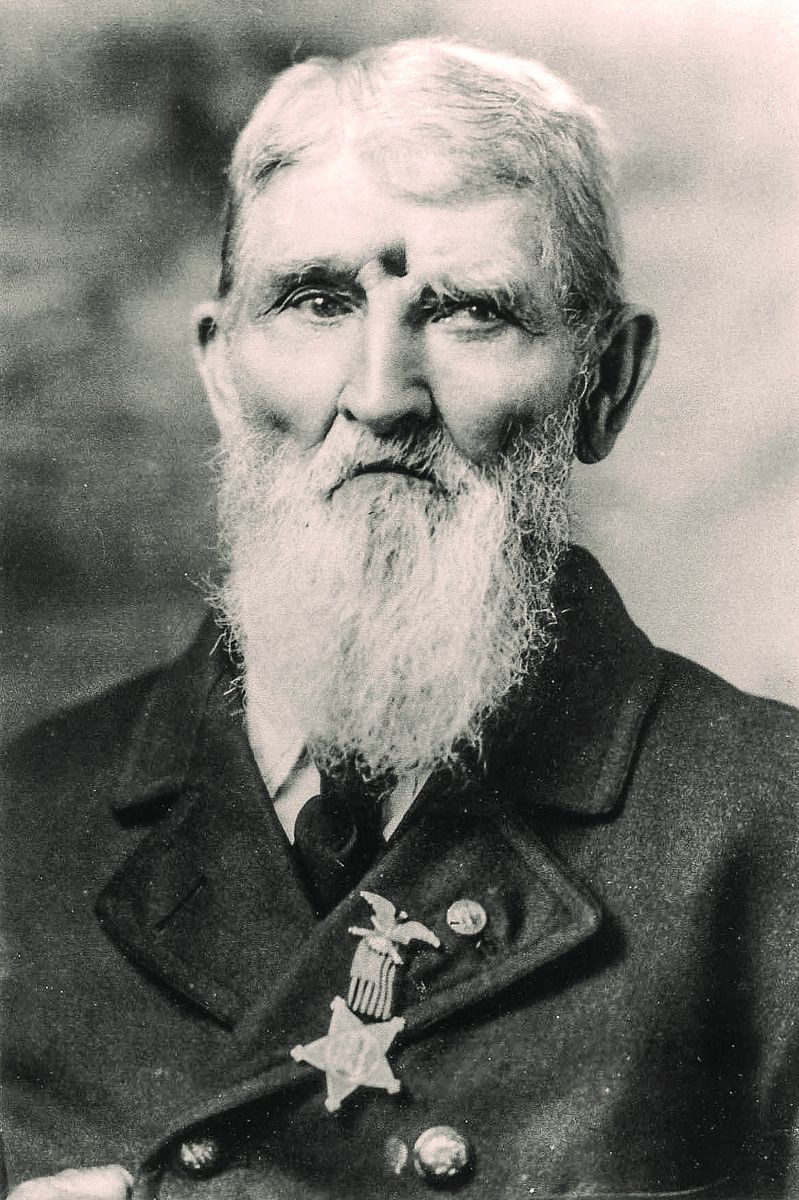
Of the 24,430 wounded Union and Confederate soldiers who fought in the Battle of Chickamauga, in Georgia, one veteran stands out as the most unusual survivor of the bloody battle. Private Jacob Miller, of Naperville, Illinois, was serving with Company K, 9th Indiana Volunteer Infantry, part of Major General William Rosecrans’s Army of Cumberland, when he was shot in the head by a Confederate sniper of Major General Braxton Bragg’s Army of Tennessee, near Brock Field on the morning of September 19th, 1863. The bullet struck him between the eyes and lodged in his skull According to historical information provided by the Cass County Historical Society, Private Miller enlisted in Company K from Logansport, Indiana at the age of 23. The 9th Indiana Regiment was mustered on April 25th, 1861, at Laporte, Indiana for three months of active service and was commanded by Colonel Robert H. Milroy, who was commissioned on April 26th, 1861. The 9th saw action in West Virginia at Grafton, Philippi, Laurel Hill and Corrick’s Ford. It was mustered out on July 29th,1861. The 9th was reorganized for three its years of active service in August 1861 and saw action at the battles of Shiloh, Perryville, Stones River, Chickamauga, and participated in Sherman’s Campaign across Georgia. Private Miller’s combat service ended the day he was shot in the head and left for dead. Miller told his remarkable story of survival which was recorded in the Daily News of Joliet, Illinois in June of 1911. After the war, he joined the Grand Army of the Republic, a veterans organization much like today’s American Legion. When he attended the encampments, his fellow war veterans nicknamed him “Center Shot” for the open bullet wound in his forehead. According to Miller, “I was in a semi-reclining position and raised up my elbow to take aim when I was hit by a rebel bullet.” His Company Commander, Captain McConnell, was standing behind him, and he thinks that the sniper was trying to shoot his Captain, but aimed too low and struck Miller instead. When Company K fell back from that position in retreat, his comrades had given him up for dead. He went on to say, “When I came to my senses some time after I found I was in the rear of the Confederate line. So not to become a prisoner, I made up my mind to make an effort to get around their line and back on my own side. I got up with the help of my gun as a staff, then went back some distance, then started parallel with the line of battle. I suppose I was so covered with blood that those that those I met did not notice that I was a Yank”. Major General Alexander P. Stewart’s CSA Division (Buckner’s Corps) routed the Union Brigades from the Brock Farm area but did not have enough forces to pursue the Union troops. Miller managed to stumble along, but on the way, he ran into a Confederate soldier who was out front scouting the lines and the rebel soldier took mercy on Miller’s plight. He gave Miller a drink of water from his canteen and pointed in the direction of the Union Line. Miller continued saying, “I struck an old by-road and followed it the best I could, as by this time my head was swelled so bad it shut my eyes and I could see to get along only by raising the lid of my right eye and look again and so on till I ran afoul of something, then would look again and so on till I came to the Lafayette Pike near the Kelly house and started towards the field hospital at the springs. I at length got so badly exhausted I had to lie down by the side of the road. At last, some bearers came and put me on their stretcher and carried me to the hospital and laid me on the ground in a tent. A hospital nurse came and put a wet bandage over my wound and around my head and gave me a canteen of water. I don’t know what time of day they examined my wound and decided to put me on the operating table till after dark some time. The surgeons examined my wound and decided it was best not to operate on me and give me more pain as they said I couldn’t live very long, so the nurse took me back into the tent. I slept some during the night. The next morning (Sunday), the doctors came around to make a list of the wounded and of their company and regiments and said to send all the wounded to Chattanooga that the ambulances would carry and told me I was wounded too bad to be moved, and if the army fell back those that were left there could afterwards be exchanged.” Miller was determined not to be taken prisoner. As long as he could stand and drag one foot after another, he would make his way to safety. He had a nurse give him a canteen full of water and left the tent without being seen. He got behind some wagons near the road and then began to walk slowly away. His eyes were still shut, and he had to lift his eyelid to see where he was going. He moved away from the sounds of the artillery and musketry fire. He recounted, “I worked my way along the road as best I could. At one time I got off to the side of the road and bumped my head against a low hanging limb. The shock toppled me over, I got up and took my bearings again and went on as long as I could not drag a foot then lay down beside the road, to see if I could not rest so I could move. I hadn’t lain long till the ambulance train began to pass.” The ambulance drivers saw Miller and asked him if he was still alive. One of them stopped and placed Miller into the ambulance. Once he was inside the ambulance, he passed out. He said, “On Monday, September 21st, I came to myself
Company “A”, 9th Indiana Infantry photographed between 1861-1865. Photograph by Mathew Brady. and found I was in a long building in Chattanooga, Tennessee, lying with hundreds of other wounded on the floor almost as thick as hogs in a stock car. Some were talking, some were groaning. I raised myself to a sitting position, got my canteen and wet my head. While doing it, I heard a couple of soldiers who were from my company. They could not believe it was me as they said I was left for dead on the field at the left of Brock Cabin. They came over to where I was and we visited together till then came an order for all the wounded that could walk to start across the river on a pontoon bridge to a hospital, to be treated ready to be taken to Nashville. I told the boys if they could lead me, I could walk the distance.” Because of the heavy military convoys of wagon trains and troops crossing the river in retreat, the wounded men had to wait until sundown to cross over. Once across the river, they met up with a wagon teamster from Company K, who got them some food, the first Miller had eaten since the morning of his wound. They laid down on a pile of blankets under the wagon to rest for the night. The teamster stayed awake all night to keep their wounds moist with water from a nearby spring. On Tuesday morning, September 22nd, they awoke to the sound of a crackling camp fire where a comrade had made coffee and some food for the wounded. Afterward, they had their wounds cleaned and dressed by a doctor and then got aboard a wagon heading to Bridgeport where they would board a train for Nashville. The wagon ride was rough. Miller’s head began to hurt, and he and his comrades got out and walked the 60 miles in four days to the train station. Along the way, Miller was able to open his right eye and could see to get around. They arrived at the train station and boarded a box car for the rest of their journey. They made it to the hospital at Nashville where Miller recalls, “I remember I was stripped and in a bath tub of warm water in a hospital at Nashville. I do not know what date it was, in fact, I didn’t pay much attention to the dates from the Friday at noon when I got in the box car at Bridgeport to start to Nashville. After some length of time, I was transferred to Louisville, Kentucky. From there to New Albany, Indiana. In all the hospitals I was in, I begged the surgeons to operate on my head, but all refused.” Miller suffered for nine months then got a furlough home to Logansport and went to see his local doctors, Doctors Fitch and Colman, and asked them to operate on his wound. They took out a musket ball and after he recovered from his operation, returned to the army hospital at Madison and stayed there until the end of his enlistment on September 17th, 1864. Miller went home and resumed civilian life despite his open wound. He had lost the vision in his left eye. Seventeen years after he was injured, a buck shot dropped out of his wound. Thirty-one years later two pieces of lead came out of the wound. For sixty-four years he lived with his open wound between the eyes that penetrated the skull three-quarters of an inch. It was large enough to place the end of his little finger into the wound, which caused him terrible pain and discomfort. During his post-war lifetime he had bouts of side effects such as a stupor for two weeks, dizziness, delirium, and when he was sick with a bad head cold, the pressure on his brain would build up and cause intense pain in his skull. The bouts of delirium would cause him to imagine he was back on picket duty again, and he would tramp back and forth on his beat, a stick on his shoulder for a musket, a pitiful object of the sacrifice for freedom. After the pieces of the bullet had fallen out of his open wound, he regained his normal health and continued living his life until the old age of 87. Miller said in his interview, “Some ask how it is I can describe so minutely my getting wounded and getting off the battlefield after so many years. My answer is, I have an everyday reminder of it in my wound and constant pain in my head, never free of it while not asleep. The whole scene is imprinted on my brain as with a steel engraving. I haven’t written this to complain of any one being in fault for my misfortune and suffering all these years, the government is good to me and gives me $40.00 per month pension.” Miller was living testimony to one of the most remarkable constitutions ever possessed by a human being.
His obituary was published in the Logansport Pharos-Tribune on January 14th, 1927 and reads: “Funeral services for Jacob “Center Shot” Miller, age 87, a well known Civil War veteran, were held at the Presbyterian Church in Braidwood, Illinois this afternoon. The Civil War veteran often visited in Logansport. His nickname is significant because of a bullet wound which he had carried from the time of the war until his death. The wound was directly above the bridge of his nose penetrated the skull.” Private Jacob Miller was buried at the Oakwood Cemetery, Will County, Wilmington, Illinois. His unit, the 9th Indiana Volunteer Infantry Regiment was mustered out of Federal service on September 28th, 1865. Of the 2,141 men who served, 353 died in the war. 11 officers and 129 enlistedmen were killed in action or died of wounds, and 2 officers and 220 enlistedmen died of disease. Private Miller considered himself one of the lucky ones who survived the war and lived a long life. A most remarkable American hero. Michael L. Kelley, MSG, USA, (Ret.) Vietnam service as a UH-1B Huey Doorgunner-Crew Chief in 1966 with the 1st Cavalry Division (Airmobile). Kelley served 7 years active duty and 15 years in the U.S. Army Reserve Active Troop Program and retired as a battalion staff training NCO from 3rd Battalion, 18th Infantry, 187th Infantry Brigade. He also retired from the Defense Logistics Agency (DPRO-Raytheon). He holds a B.A. Degree in History from Boston State College.