
The Graphic War
Massachusetts Militia Prepares for War
By Salvatore Cilella · Originally published September-October 2026 · pp. 58–60
The Graphic War highlights prints and printmakers from the Civil War discussing their meaning and the printmaker or artist’s goals.
Long before European settlement, Winter Island was home to the Naumkeag people. The island sits in Salem Harbor and is connected to Salem Neck in Salem, Massachusetts. Situated on the western side of the harbor, it consists of 38 acres of fairly level ground and is approximately a half mile long.
After English colonists arrived, “it quickly became the center of the fishing industry in Salem after fishing stages were constructed on the island in 1629.” The colonists probably gave the island its name. Fishermen stored their boats in a harbor on the island during the winter to protect them from the weather. The earliest known military use of
Figure 1. Camp Banks, Aug 25th, 26th, & 27th 1858 Encampment of the 2d Div. of M.V.M. on Winter Island, Salem Harbor.
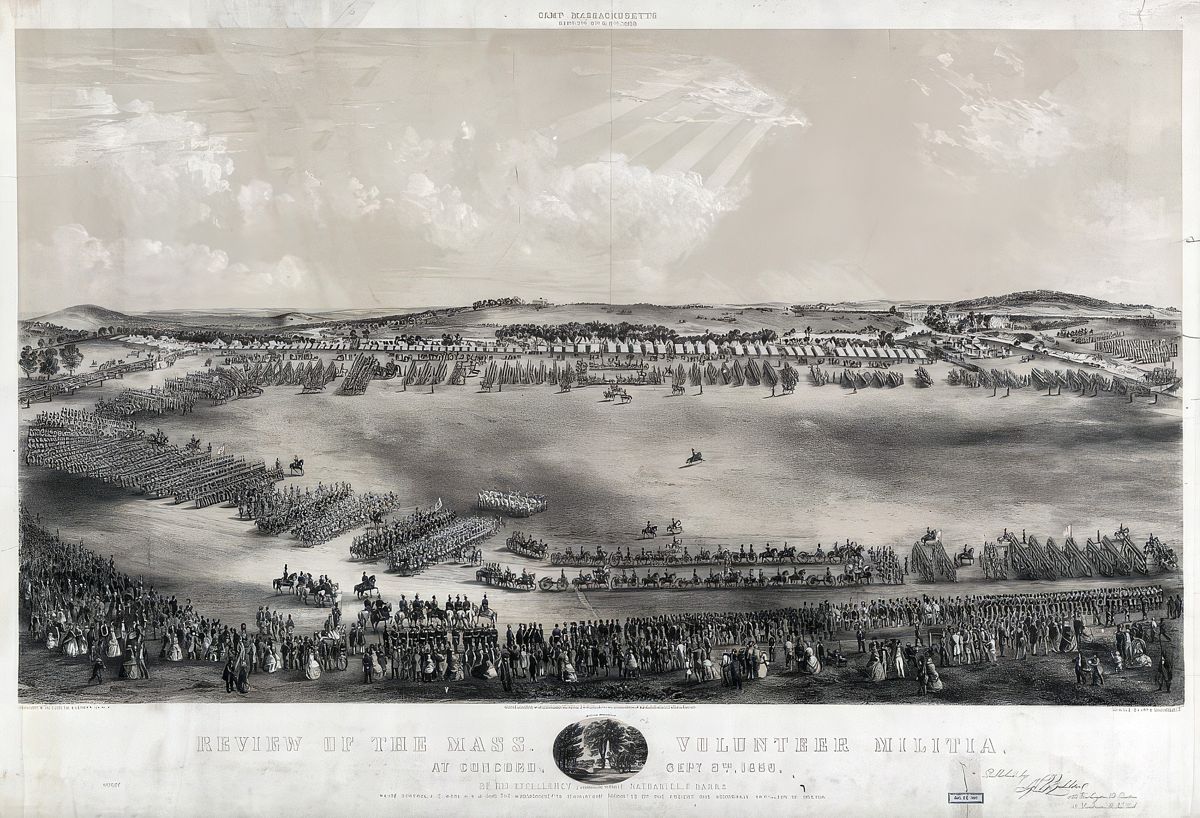
the island occurred in September 1856, when the Fourth Brigade of the militia maneuvered there.1 In the 19th century, the island became the locus of “Salem’s growing commerce, its sunny slopes were covered with the nets, the flakes, and the warehouses of the fisherman, and their shallops floated in the surrounding waters.” Unfortunately, the harbor’s shallow waters could not sustain larger vessels, and the commercial lure of deep-water docks prevailed.2 When the military began using the island, its activities drew spectators from miles around. “Salem Neck was lined with tents and shanties, and steady stream of soldiers and military vehicles could be seen traveling back and forth across the neck to the camp, creating dust clouds everywhere. Large crowds of spectators would also swarm the island hoping to view the encampment and listen to the marching bands.”3 Massachusetts nurtured its militia forces prior to the Civil War. In 1860, the state’s adjutant general reported 152,112 enrolled militia, 5,739 of whom were active. The active troops were organized into three divisions consisting of six brigades, nine regiments, seven battalions, and 87 companies. Those units included artillery, dragoons, riflemen, infantry, and cavalry. “During the year 200 officers…(were) commissioned and 215 discharged” with 30 vacancies at year-end.4 Two years earlier, the May training day had been abolished, and “all companies containing less than thirty-two privates” had been eliminated. Even though the adjutant general boasted that “the Volunteer militia of the State has never been more thoroughly organized, nor in better condition than at the present time,” 1859 tallied a decrease in enrollees. The number of companies dropped from 95 to 87.5 It was in those two years prior to the war that John Badger Bachelder, a New England landscape painter, portrait artist, lithographer, and photographer, captured two Massachusetts militia gatherings. He came to the subject through attendance at military schools in New England and later served as principal of the Pennsylvania Military Institute in 1851. Later in life, he became known as the official historian of the Battle of Gettysburg. Before that later Gettysburg work, he memorialized the encampment of the 2nd Division of the Massachusetts Volunteer Militia on Winter Island in a large lithograph titled “Camp Banks.” In minute detail, Bachelder captured the moment the division occupied the island from August 25–27, 1858. It was “Drawn from Nature” by Bachelder and “assisted by Photographs by J. W. Moulten,” and it is a treasure trove of documentation regarding the Massachusetts militia. He identifies landmarks including Beverly Harbor, Parker’s Lighthouse, Lowell Island, Fort Pickering, Naugus Head, Marblehead Shore, and Salem Inner Harbor. In the text in the left title margin, Bachelder identifies “General Butler’s Quarters; Third Brigade, Brig General Benjamin F. Butler; Second Battalion of Rifles, Major E. Moore; Fifth Regiment, Col. C.B. Rogers; Sixth Regiment, Col. E. F. Jones; Fourth Brigade, Brig Gen Joseph Andrews; First Battalion of Rifles, Major Ben Perley Poore; Seventh Regiment, Col. Lyman Dike; Eighth Regiment, Col. Fred J. Coffin; Gen Andrews’ Quarters.” In the right margin, he notes, “His Excellency, Hon. Nath. P. Banks & Staff accompanied by Adj. Gen. E. W. Stone Escorted by the Waltham Dragoons, Capt. Wm. Gibbs; Maj. Gen Wm Sutton’s Quarter’s; Divisionary Corps of Cadets, Capt. S. B. Foster.” Sutton was the commanding officer of this encampment. Bachelder seemingly left nothing out of his massive undertaking. In the foreground, a cavalry unit drills, surrounded by tents and civilians in period dress. To the left is an artist sketching the scene, which is most likely a selfportrait of the artist. The encampment is filled with tents and drilling troops, with a large American flag flying in the wind. In the background, the harbor is filled with various boats and ships. The print is dedicated to Governor Nathaniel P. Banks. Banks’s record as a Civil War general is well known. His actions as governor resonate today. He supported a KnowNothing amendment to the Massachusetts Constitution requiring immigrants to wait two years before being allowed to vote and supported bills allowing only whites to participate in the state militia. One month before John Brown’s raid, Bachelder captured the review of the Massachusetts Volunteers at Concord,
September 7, 8, and 9, 1859. The review was led by Governor Banks and Major General J. E. Wool, U.S. Army, with the Massachusetts Legislature escorted by the Ancient and Honorable Artillery Company of Boston. The earlier print was large; this one was much larger, measuring almost 3 feet by 4 feet. It was so large that Bachelder chose not to attempt identifying the multitude of military units participating. John Ellis Wool was born three years after Cornwallis surrendered at Yorktown. He was the oldest officer in the U.S. Army, having served in the War of 1812, the Mexican War, and the Civil War. He was heavily involved in the removal of Cherokees from their lands, sending them on the Trail of Tears. He was 77 when the Civil War broke out and held seniority over others, including Winfield Scott. When Bachelder depicted him at the encampment at Concord, he was commander of the Department of the East.6 In less than two years, the Massachusetts militia would trade the pomp and circumstance of military reviews for four years of the horrors of war. Massachusetts sent more than 160,000 men to fight during the war. One day after the fall of Fort Sumter, Governor John A. Andrew activated the 8th Massachusetts Volunteer Militia. On April 19, 1861, the 6th Massachusetts, on its way to Washington, was attacked by a pro-Southern mob in Baltimore. It was the anniversary of the Battles of Lexington and Concord, and the men were dubbed “The Minutemen of ’61.”7 Endnotes 1.
Rebecca Beatrice Brooks, “History of Winter Island in Salem, Massachusetts,” History of Massachusetts Blog, January 17, 2022, https://historyofmassachusetts.org/winter-island-salem-history/. Gilbert L. Streeter, “The Story of Winter Island and Salem Neck,” Essex Institute Historical Collections 33 (1898): 105–128, 117. Ibid., 126. “The Massachusetts Militia,” The New York Times, February 22, 1860. Massachusetts Adjutant General’s 1859 report, 28, as cited in Paul T. Smith, “Militia of the United States from 1846 to 1860,” Indiana Magazine of History 15, no. 1 (March 1919). Ezra J. Warner, Generals in Blue: Lives of the Union Commanders (Baton Rouge: Louisiana State University Press, 1964), 573–574. George Lowell Austin, The History of Massachusetts from the Landing of the Pilgrims to the Present Time (Boston: B. B. Russell, Estes & Lauriat, 1876), 492.
www.jamescountry.com his time to collecting A merican prints and maps and writing. He has written extensively on Emory Upton:
Upton’s Regulars: A History of the 121st New York Volunteers in the Civil War (Kansas, 2009); a twovolume Correspondence of Major General Emory Upton, (Tennessee, 2017), received the 2017–2018 American Civil War Museum’s Founders Award for outstanding editing of primary source materials. He edited Upton’s love letters 1868-70 to his wife–Till Death Do Us Part (Oklahoma, 2020), and The Memoirs of Dewitt Clinton Beckwith of Upton’s Regulars (McFarland, 2023).