
Vision and Valor: The War Through Women’s Eyes
“Let the Sutlers Know We Take in Washing”
By Juanita Leisch Jensen · Originally published September-October 2026 · pp. 22–25
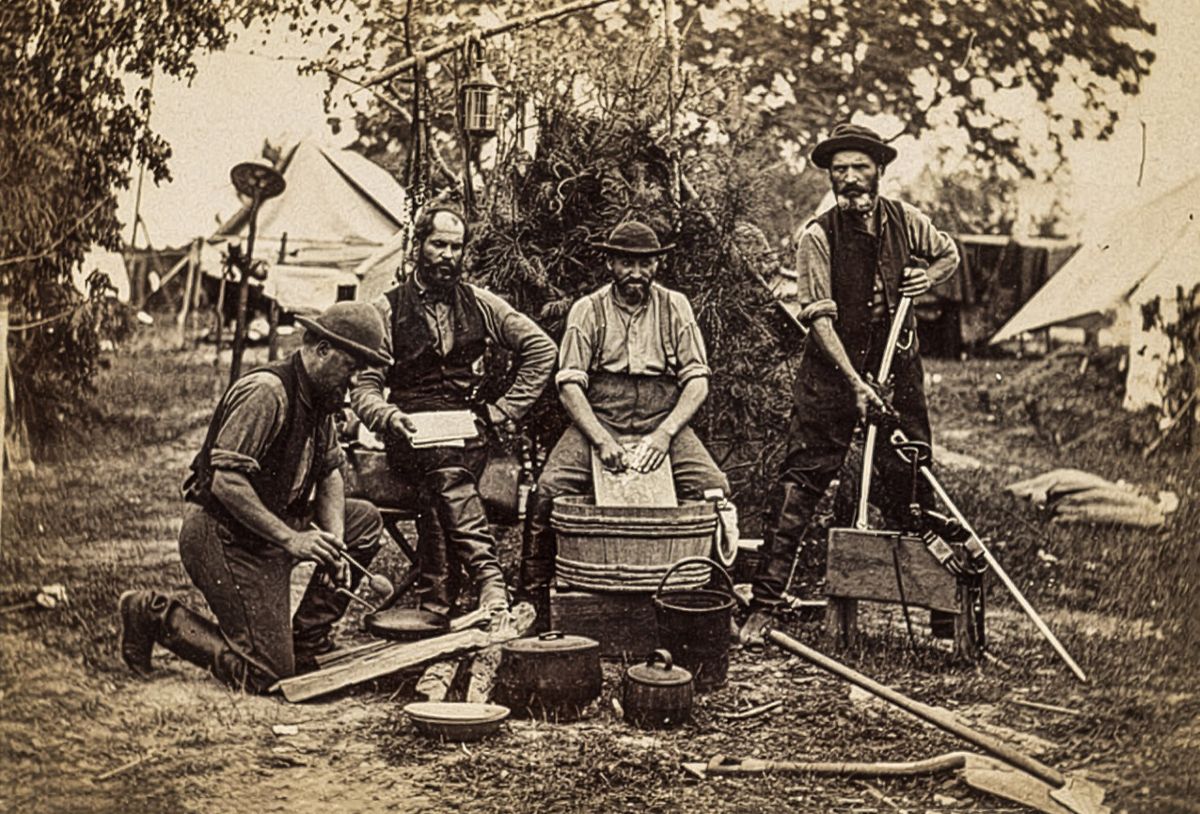
Research on militarily significant roles of women in the Civil War reveals one role, that of washerwoman, that was deemed so important it was specified in U.S. Army regulations. Women willing to take on this work were offered housing, medical care, food rations for themselves, and half-rations for their children. The regulations also specified that washerwomen assigned to companies would be paid by the soldiers, while those assigned to hospitals would be paid directly by the Army. Army regulations specified four women per company, but correspondence and official records indicate that more positions were left empty than filled.
We have lots of dances most every night. … It makes the time fly fast & the boys merry. But the worst is we have only one woman in the regiment. That is singular, you will think, but each company is allowed four women but there is only one. Her husband is with her, so we see a woman once & a while. Joseph J. G. Nellist 28th New York Inf. Camp Near Darnestown [Maryland] October 18, 1861 (https://sparedshared23.com/2026/05/27/1861-joseph-j-gnellist-to-loretta-root-nellist/)
Whether in civilian or military life, doing laundry was hard, undesirable work. In addition to hauling and heating heavy buckets of water, laundresses had to lift, wring out, and spread heavy, wet fabric and immerse their forearms in boiling water. Laundry was one of the first tasks assigned to servants or outsourced entirely. In her widely read work on domestic economy, Catharine Beecher advocated outsourcing the entire laundry process to communal laundries, saying, “Whoever sets neighborhood laundries on foot will do much to solve the American housekeeper’s hardest problem.”1 Even in military camps, laundry was occasionally assigned to servants rather than Army laundresses.
Lizzie Ward, the Reluctant Laundress The prominently placed basket of laundry and the washtub and washboard at the extreme right of this photograph offer evidence that the woman pictured performed laundry work. (Library of Congress)
The women who served as washerwomen did not leave diaries, letters, or journals recounting their experiences. Many were probably not literate. Fortunately, one literate and scholarly Civil War soldier left a detailed diary recounting the story of his wife, Lizzie Ward, a reluctant laundress. Assigned to a hospital in Alexandria, Virginia, Civil War soldier Lester Ward found it difficult to be separated from his bride and was thrilled at the prospect that she might take a position in the hospital laundry. He reported in his diary that Lizzie arrived, acquired equipment, and began doing laundry. In short order, however, it was not Lizzie alone but Lizzie and Lester who were doing the washing. Once Lizzie found other means of making money, Lester’s diary made no further mention of taking in laundry.
January 2 – The Lieutenant has just been talking with me regarding the possibility of having a laundress. He suggested that they employ a Negro woman and that I have my wife come to supervise her. What a grand project!2
This photograph of U.S. Christian Commission operations at White House Landing, Virginia, shows a woman doing laundry (see close up on right). (Library of Congress)
January 14 – Lieut. Wallace … told me that he had just been talking with Dr. Smith about the business of having my wife come to oversee the washing for the 86th company. The Doctor regards the project with favor. The Lieut. wished me to send for her immediately. What joy I feel! I am going to do it.3 Feb 12 – They are going to reestablish the Hospital laundry and have taken seventeen men from us for it.4 Feb 20 – I went to Alexandria … and we bought … washing equipment, and other labor saving tools.5 Feb 22 – The commissary have brought us some soiled uniforms to wash,. … Lizzie has done a little washing.6 Feb 23 – Lizzie has washed several uniforms. 7 March 30 – Lizzie has not done much before today. Yesterday she washed some uniforms and I helped her.8 April 3 – Mr. Henderson … bought a machine to wring out the uniforms.9 April 24 – We did a big washing Thursday and made a dollar and a half from it. May 22 – What we receive from time to time for the washing and for the rations pays all our expenses.10
June 26 – We are beginning to get more washings, because Mrs. Henderson has stopped taking it, and directs everyone to us.11 August 15 – A week ago today I bought a fryingpan from Corporal Henderson. Four families use it, and pay me fifteen cents a week. We have already received seven dollars and a half of the ten which I have spent.12 August 21 … We have saved more than ten dollars since I bought the frying-pan. From the moment they began making money by renting out the frying pan, Lester’s diary made no further mention of taking in laundry from customers.
July 30, 1865 Exactly a year of my history is recounted in this volume. Then I was a soldier, subject to the orders and outrages of the officers, to whom I could offer instruction myself. Now I am a citizen, surrounded by all the happiness of a citizen. Then I received irregularly 20 dollars a month. Now I get almost a hundred. Then a great war ravaged the land. Now all is peace. What changes, what an age, what a country!
“We pay a dollar a week to an old Negro woman to wash our clothes.”13 For the military, the presence or absence of laundresses to wash clothing was only one part of the story. In hospitals and on hospital transport boats, massive quantities of bed linens, as well as clothing, needed to be laundered. The United States Sanitary Commission and the United States Christian Commission provided large quantities of bed linen and hospital clothing; in some cases, they also provided laundry services. Mary A. Livermore, an agent with the U.S. Sanitary Commission, described how her fellow agent, Mother Mary Bickerdyke, attacked the laundry problem.
Up to this time, no attempt had been made to save the clothing and bedding used by the wounded men on the transports and in temporary hospitals. Saturated with blood, and the discharges of healing wounds, and sometimes swarming with vermin, it had been collected and burned or buried. But this involved much waste; and as these articles were in constant need, Mother Bickerdyke conceived the idea of saving them. She sent to the Commission at
Chicago for washing-machines, portable kettles, and mangles, and caused all this offensive clothing to be collected. She then obtained from the authorities a full detail of contrabands, and superintended the laundering of all these hideously foul garments. Packed in boxes, it all came again into use at the next battle. This work once begun, Mother Bickerdyke never intermitted. Her washing-machines, her portable kettles, her posse of contrabands, an ambulance or two, and one or two handy detailed soldiers, were in her retinue after this, wherever she went. How much she saved to the government, and to the Sanitary Commission, may be inferred from the fact that it was no unusual thing for three or four thousand pieces to pass through her extemporized laundry in a day.14 The story comes full circle when, on August 13, 1865, Lester reported:
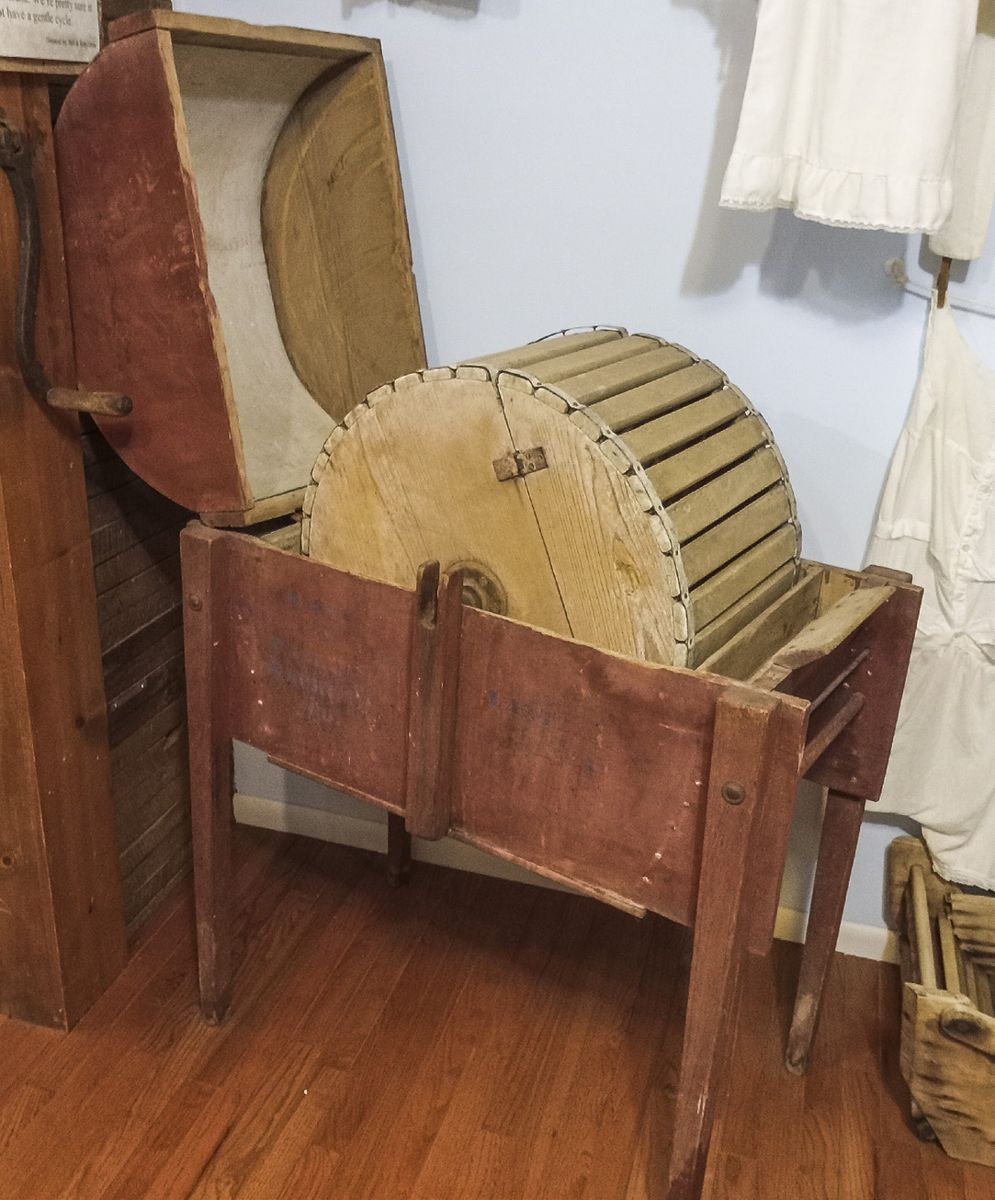
This wooden washing machine, manufactured by the Shenandoah Washing Machine Company of Lantz Mills, Virginia, follows the basic design of an 1844 patent for a “Washing Machine.” The machine is on exhibit in the Edinburg Mill, just 15 miles from where it was manufactured. (Shenandoah Valley Cultural Heritage Museum)
Just after I had got through drilling, I had some washing to do so I went to the place where all the men go to wash their clothes. If you had been here you would laugh yourself almost to death to see them washing. I should think there was about 50 men washing their clothes. … one making fun of another to see them wash. The boys keep their clothes pretty clean. They wash their clothes once a week. I have my week’s washing done and out a drying on my tent. I can beat any lady washing without a wash board. My clothes look as clean and white as snow. Will has been washing too. He has got his drying too.
Philo E. Ruggles 122nd New York Infantry to his Parents Camp near Williamsport, October 8, 1862 (Source: https://sparedshared23.com/2025/05/30/1862philo-e-ruggles-to-his-parents/)
The classic washtub and washboard served well for generations. Given the drudgery of laundry, however, it is little wonder that labor-saving innovations were adopted. The term “washing machine” was familiar even to soldiers and prisoners of war who had no access to such devices. Washing machines had been patented and manufactured in the United States well before the Civil War. The soldiers engaged in washing clothes were familiar enough with actual washing machines that they sometimes termed themselves “washing machines,” as in the watercolor by John Jacob Omenhausser.
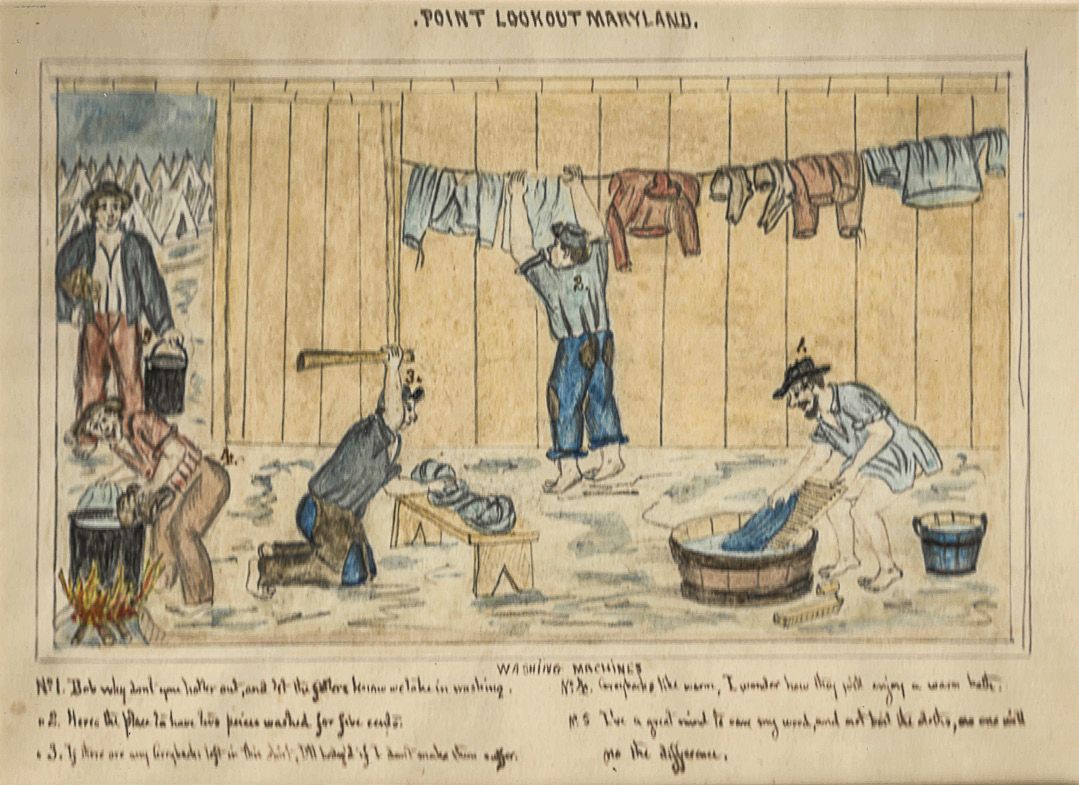
POINT LOOKOUT MARYLAND No. 1. Bob why don’t you holler out, and let the sutlers know we take in washing. No. 2. Here’s the place to have pieces washed for five cents. No. 3. If there are any greybacks left in this shirt, I’ll bedog’d if I don’t make them suffer. No. 4. Greybacks like warm, I wonder how they will enjoy a wrm bath. No. 5. I’ve a great mind to save my wood, and not boil the clothes, no one will no [sic] the difference. The U.S. Army recognized that clean laundry contributed to soldiers’ health and morale and extended the useful life of uniforms. Still, the logistics of laundry operations proved an ongoing and significant challenge for the Army, its soldiers, and its hospitals.
Sources:
Beecher, Catharine, and Harriet Beecher Stowe. The American Woman’s Home; or, Principles of Domestic Science. Hartford: The Stowe-Day Foundation, 1994. Originally published 1869. Baker, Nina Brown. Cyclone in Calico: The Story of Mary Ann
This sketch in watercolor and pencil from Point Lookout, Maryland, is attributed to Private John Jacob Omenhausser, Co. A, 46th Virginia Infantry, who spent a year as a prisoner at Point Lookout Prison Camp. The conversational caption of this watercolor indicates that a primary objective in washing clothes was to exterminate vermin. (Private Collection)
Bickerdyke. Boston: Little, Brown and Company, 1952. Cowan, Ruth Schwartz. More Work for Mother: The Ironies of Household Technology from the Open Hearth to the Microwave. New York: Basic Books, 1983. Livermore, Mary A. My Story of the War: A Woman’s Narrative of Four Years Personal Experience. Hartford, Connecticut: A. D. Worthington and Company, 1888. Ward, Lester. Young Ward’s Diary. Edited by Bernhard J. Stern. New York: G. P. Putnam’s Sons, 1935.
Endnotes: 1. Beecher, 334. 2. Ward, 127–128. 3. Ward, 130. 4. Ward, 136. 5. Ward, 137. 6. Ward, 138. 7. Ward, 138.
Juanita Leisch Jensen is a nationally recognized speaker, author, researcher (and avid collector) of topics related to civilians and the Civil War.
Juanita can be reached at [email protected] to arrange talks and presentations on topics related to civilians and the Civil
War. She is the author of Who Wore What: Women’s Clothing 1861–1865 and An Introduction to Civil War Civilians.
- Ward, 141. 9. Ward, 141. 10. Ward, 144. 11. Ward, 145. 12. Ward, 147. 13. Ward, 178. 14. Livermore, 487–488.