
THE UNFINISHED FIGHT: THE BELGIAN MUSKET IN THE CIVIL WAR
By Craig L. Barry · Originally published September-October 2025 · pp. 16–19
There were many European smoothbore muskets (manufacturers), in Liege during the War. The Belgian gunin use on both sides early in the U.S. Civil War. In maker’s business plan was to “produce cheaper copies of general, if the quote in the heading is to be believed, well-known arms” such as the Prussian (German) Potsdam, the Confederates thought more highly of these imported British Brown Bess, and French Charleville muskets. Later, arms than Union soldiers. Liège-Belgium was a center for hundreds of thousands of British Pattern 1853 rifle muskets, manufacturing a variety of military and sporting firearms. including a fairly large number for the British, and French It is one of the oldest Minié rifles with backcenters of gun-building locks and enormous in the world, and home snout-like hammers of the oldest continually were turned out. running proof house The lack of any easily (1672) still in operation. discernible maker’s “Our army was rigged out in full During the Civil Warmark was a dead suits of Yankee clothes yesterday, era an unknown number giveaway a particular but as several had been taken up were imported to the musket was produced for Yankees by our cavalry, Gen. U.S. and C.S. Liege had by the Belgians and Jackson ordered the clothes to be been producing military not a French or English muskets at a rate of less manufacturer. Most given up, so again we see our old than 10,000 per year gun-makers made sure Confederate gray, while yesterday until 1849, but by 1860 their marks were unique everything was Yankee blue. I do the proof house was and plainly visible. The not care to get any clothes, but I testing and accepting illegal engraving of have one of their famous Belgian over 500,000 barrels fake British gun-maker muskets and indeed it is an per year. Belgian gun marks on Belgian making used a system muskets was a problem arm to fear, a perfect cannon.” where the division of in the gun trade. W. – Charles Turner, Liberty Hall labor was carried out Greener and Isaac Volunteers, May 27, 1862.” to great extremes, with Hollis (Birmingham) each of approximately both won judgments twenty different trades against a competing gun specializing in one making firm engaged in individual aspect of the practice. producing the firearm. About ninety different manufacturers The U.S. and C.S. governments both had purchasing registered for proof performing the final set up and agents in Europe by mid-1861. The memoirs of Marcellus assembly. Hartley, a Federal purchasing agent in Europe records the Malherbe, Ancion, G. Schupen, Dumoulin, A. following from his extensive correspondence to Secretary Francotte, and Lemille were some well-known “houses” of War, E.M. Stanton in 1862:
“That makes in all 18,250 ordered in Liege 69/100 (.69 caliber) today, all of which will leave Europe on November 5…” He does not specify exactly which kind of Belgian muskets were purchased in Liege, but from the bore size (.69 caliber) suggests they were older smoothbore muskets, likely converted from flint to percussion at Liege. Herman Boker, another Federal arms buyer in Europe, procured 188,054 muskets of various calibers between November 1861 and May 1862, although most purchases of foreign muskets ceased by the end of 1862, when domestic production was better able to meet the army’s needs. Unfortunately the exact models and country of origin are not broken down in the Official Records. A Belgian musket is entirely different from a Belgian conversion musket. The term Belgian musket refers to any musket imported from or made commercially at Liege, Belgium. However, a Belgian conversion refers to any kind of flintlock musket regardless of country of origin that has been altered to percussion by the common “cone-in-barrel” method. The so-called “cone-in-barrel” conversion was frequently called a “Belgian alteration” because so many were changed over at Liege. A musket could certainly be both a Belgian musket and feature a Belgian cone in barrel alteration but the terms are not synonymous. How was the Belgian conversion produced? The gunsmiths stripped the older smoothbore muskets of obsolete flintlock parts, including external springs, and
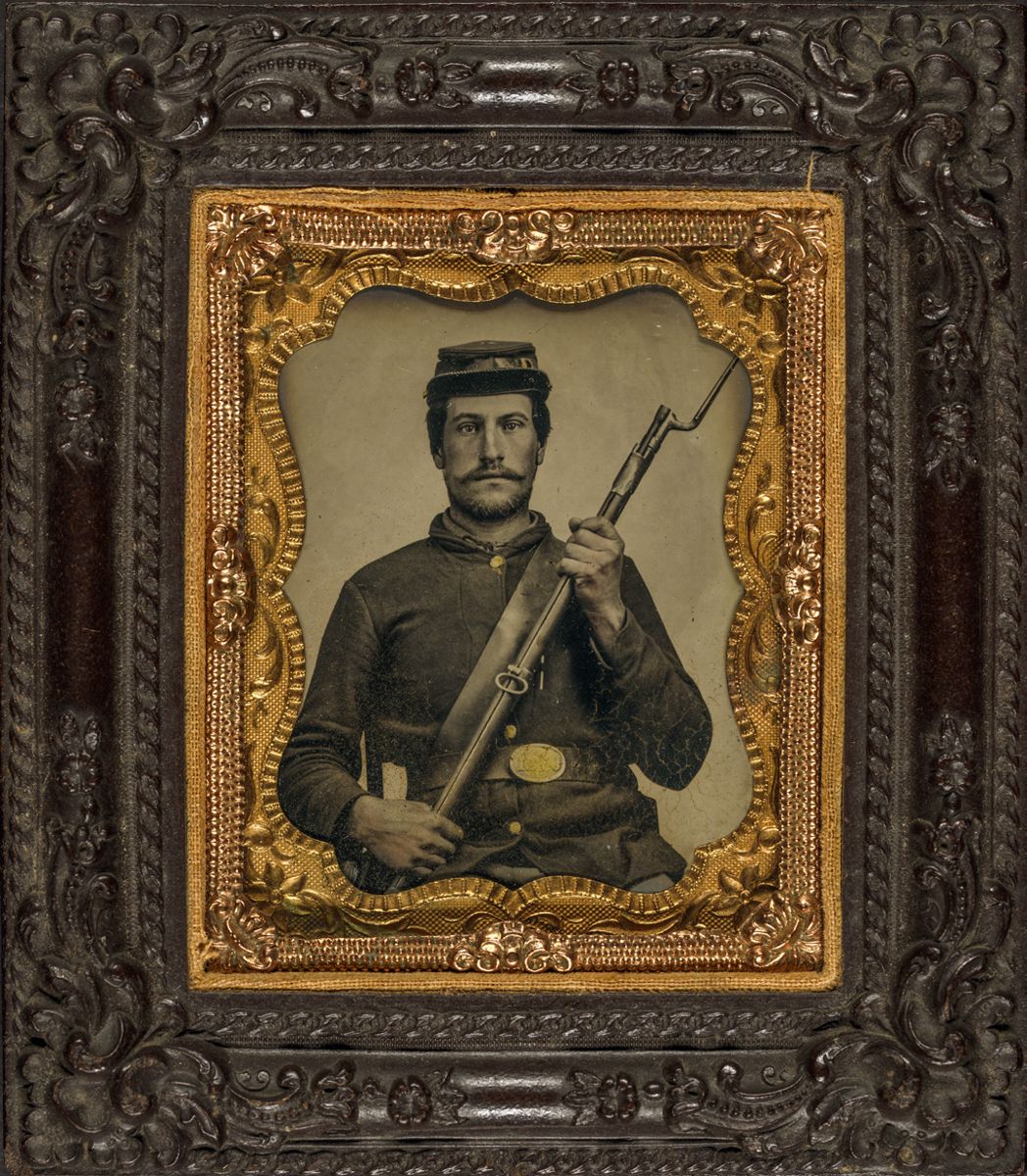
Private William F. Bower of Company D, 21st Ohio Regiment Infantry Volunteers, with bayoneted musket. Liljenquist Family collection (Library of Congress)
switched the hammer to an offset percussion design. The flash pan was ground down and the touch hole in the barrel was brazed shut. The barrel was built up slightly just to the right of top, near the breech. A hole was then drilled straight down into the bolster, and threaded for a percussion cone. Another term for this very common alteration was “Arsenal conversion,” as hundreds of thousands of older flintlock U.S. muskets, mostly U.S. Model 1816/22, were similarly changed over to the percussion system at Harpers Ferry and Springfield. These saw heavy use on both sides. Of these converted flintlock muskets, General Ulysses S. Grant wrote in his memoirs:
“The small arms of the enemy were far superior to the bulk of ours. Up to this time our troops in the West had been limited to the old United States flint-lock muskets changed into percussion,, or the Belgian musket imported early in the war; almost as dangerous to the person firing it as to the one aimed at.” Leander Stillwell noted this as well in his memoirs, Story of a Common Soldier of Army Life in the Civil War18611865. Stillwell confirms Grant’s observations about the Belgian muskets saying
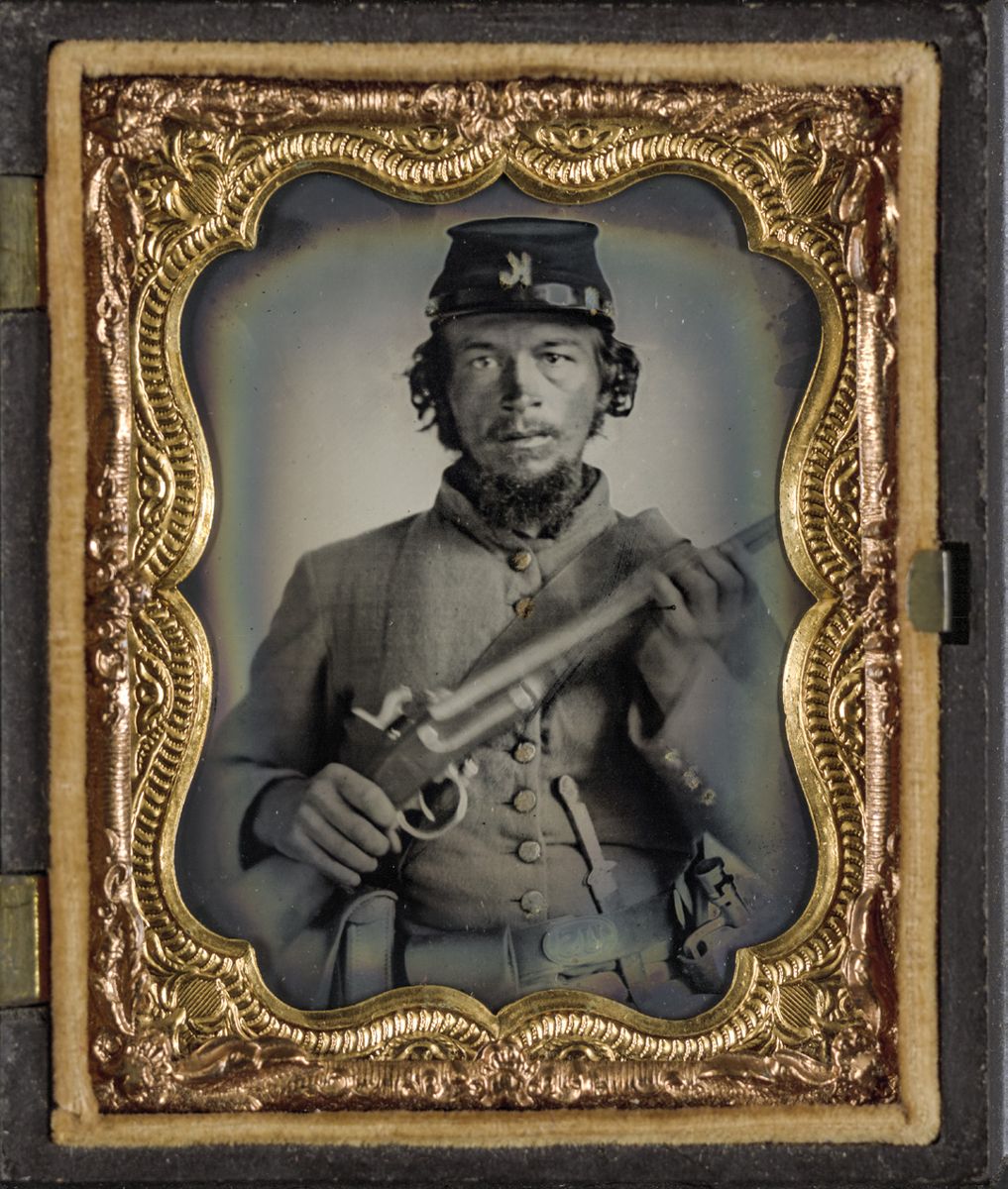
Soldier in uniform soldier holding a U.S. smoothbore musket, and wearing a cartridge box, percussion cap box, US belt buckle, bayonet and scabbard, and small side knife. Liljenquist Family collection (Library of Congress)
“…at that time most of the western troops were armed with foreign made muskets imported from Europe.” He further described the weapons as follows; “Many regiments had old Belgian muskets, a heavy, cumbersome piece, awkward and unsatisfactory in every way.”
No doubt exaggerating for effect, an Illinois Colonel once quipped,
Of the accuracy limitations of smoothbore muskets, General Grant further recalled:
When asked how one could make such a determination, the officer responded
“You might fire at a man all day from a distance of 125 yards without him ever finding it out.”
“Oh, by counting the men on the ground…the Belgian muskets kick like a mule, and burst with the greatest facility. We have lost several men in our company this way.”
“In platoon firing with the Belgian muskets, I can tell what I can not with any other arm; that is how many pieces have been fired.”
Grant is perhaps exaggerating for effect or else he is making excuses for poor marksmanship. He is also lumping together both U.S. Model 1822s with the Belgian type percussion conversion, as well as actual muskets imported from Belgium. Perhaps the same complaints are true of both, and these “old style muskets” were already considered “second class arms” by the Ordnance Department and put into service out of desperation. It is true that at distances greater than 100 yards, the “hit rate” of a smoothbore musket shooting a single round ball at a solitary target down range is, on average, 42 out of 100. However, a smoothbore musket using buck and ball rounds, which consisted of one .656 or .626 sized round ball and three smaller .31 buckshot, the “hit rate” at anything less than 200 yards becomes dramatically higher, 79 to 84 hits out of 100 rounds fired. Round balls from a smoothbore, barrel leveled, will stay in the head-to-ankle “anti-personnel” height for most of its entire trajectory while the buckshot spreads out, causing collateral damage. The muzzle velocity of a smoothbore is about 1,600 feet per second, compared to 970 feet per second for a riflemusket, so it also packs more punch. While you would not be pleased to be struck by a missile fired from either arm, this much can be said of the smoothbore musket; Firing at massed formations in a battle line at anything less than 200 yards, the smoothbore musket loaded with buck and ball was a more than formidable weapon. At anything over 200 yards, the buckshot will have lost the ballistic energy, decelerated, to do as much damage.
Craig L. Barry was born in Charlottesville, Va. H e holds his BA and M asters degrees from UNC (Charlotte). Craig served The Watchdog Civil War Quarterly as Associate Editor and Editor from 2003– 2017. The Watchdog published books and columns on 19th-century material. He is the author of several books including The Civil War Musket: A Handbook for Historical Accuracy (2006, 2011), The Unfinished Fight: Essays on Confederate Material Culture Vol. I and II (2012, 2013). He has also published four books in the Suppliers to the Confederacy series on English Arms & Accoutrements, Quartermaster stores and other European imports.
The N-SSA is America’s oldest and largest Civil War shooting sports organization. Competitors shoot original or approved reproduction muskets, carbines and revolvers at breakable targets in a timed match. Some units even compete with cannons and mortars. Each team represents a specific Civil War regiment or unit and wears the uniform they wore over 160 years ago. Dedicated to preserving our history, period firearms competition and the camaraderie of team sports with friends and family, the N-SSA may be just right for you.
For more information visit us online at www.n-ssa.org.
NOTICE AND DISCLAIMER Dear Valued Subscriber, Thank you for choosing Civil War News magazine. We are dedicated to providing our subscribers with timely and reliable service. To ensure clarity regarding our subscription policies, please review the following important details: 1. One-Issue Replacement Policy Once an issue has been mailed and dispatched to the distribution center, we cannot replace it free of charge if it is not delivered, as this is beyond our control. We offer a one-time replacement of a single magazine issue per subscription within a three-year period if it is not received due to a mailing issue or other circumstances. 2. Address Change Notification If you plan to move or update your mailing address, please notify us immediately. Once our mailing list has been sent to the distribution center, we cannot reroute or replace issues already in transit. To ensure uninterrupted delivery, we strongly recommend providing any address changes well in advance. 3. Subscription Renewal Notices As a courtesy, we send renewal reminders via U.S. mail to the address on file. We also send notices by email whenever possible. To help keep subscription costs low and avoid service interruptions, we kindly request that subscribers renew their subscriptions promptly. Timely payments allow us to minimize administrative costs and continue delivering high-quality content. Thank you for being a valued subscriber of Civil War News. NOTE: The USPS is running extremely slow, so please be patient with delivery. We send the issues to the printer on time, every time. Thank you for understanding. – Jack W. Melton Jr. – Publisher
We Buy and Collect Rare Confederate and Southern Obsolete Currency.
Since 1978, we have collected or handled over 80 of the “Big Six” Confederate Notes to include nearly 10% of all known surviving Montgomery Notes.
Greg Ton
901-487-5944 • [email protected] • Franklin, TN
GregTonCurrency.com
Carman, Harsh, Sears, Priest, Hoptak, Hartwig, Jordan, and all others Refuted!! Autographed hardcover copies $26 delivered!! Send an email to: [email protected] Gen. J. D. Cox: “He [Hood] tells also of recovering the crest of South Mountain in the battle of 14th September 1862, after the Union troops had carried it. It has been abundantly demonstrated that the principal ridge south of the Hagerstown pike was never for a moment in real danger after the 9th Corps had gained it in the morning. A detached hill in front was alternately held by both sides but never occupied in force by Federal troops. It is to this alone he can refer.”
Casemate Publishers
Marcy & Pleasonton: Confederates surrounded on three sides!!!!
“This is a must-read.” - Scott L. Mingus, Sr. Hardcover, E-book, Audible Audiobook!
Photographs from the Original Article

Captions and credits appear in the article text as originally printed.