
Central Virginia Battlefields Trust Vision and Valor:
By Tim Talbott · Originally published November-December 2025 · pp. 56–61

Central Virginia Battlefields Trust
Early Visitors to Central Virginia’s Battlefields – Part I By Tim Talbott
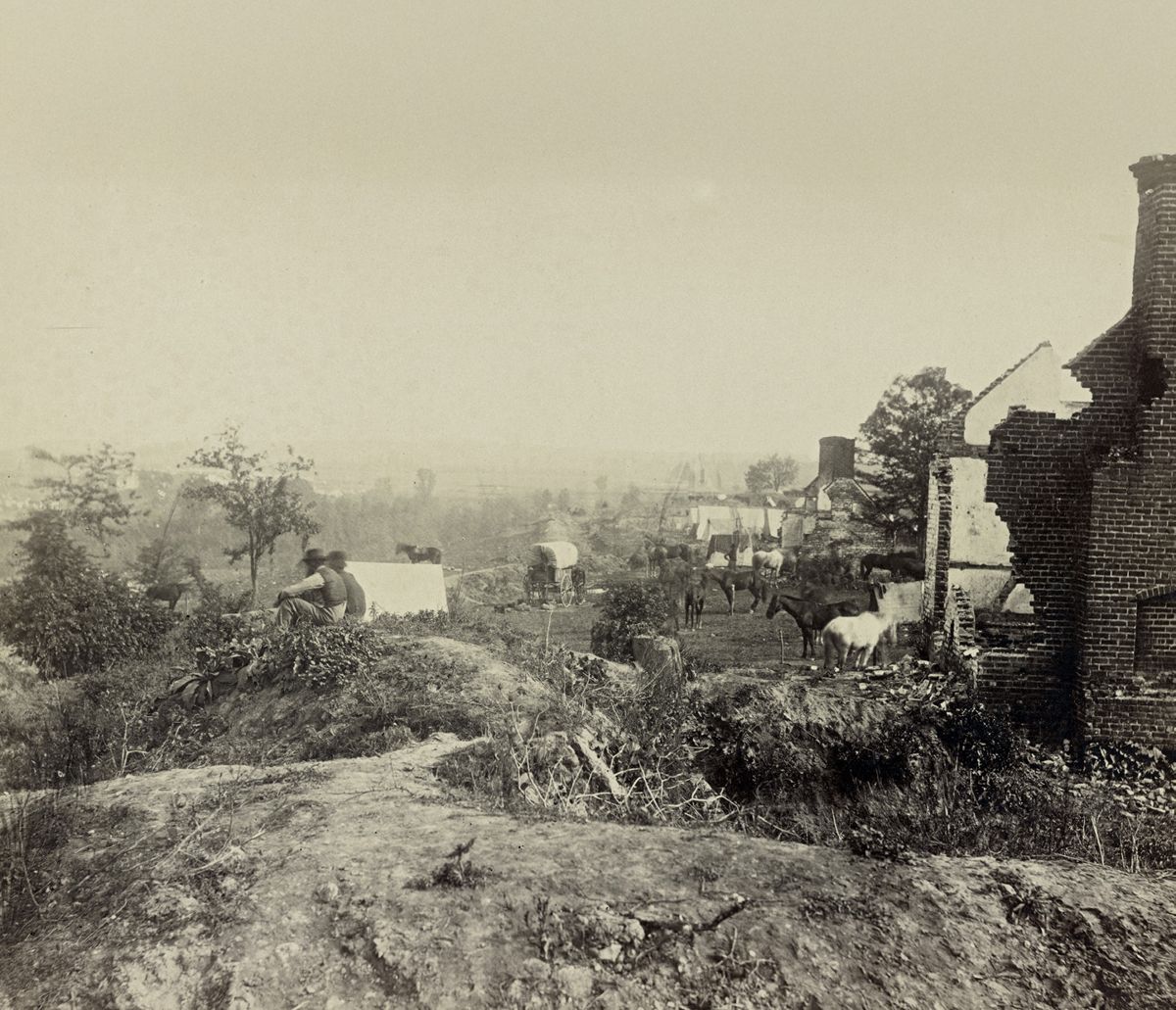
In December 1883, twenty-one years after the Battle of from the paved roads, utility lines, and automobiles that Fredericksburg, George C. Smithe, formerly a corporal we benefit from—yet at times disdain—today. Those in the 35th New York Infantry, and then in his midearly battlefield sightseers got a truer, firsthand look at the forties, returned to the scene of that furious December landscape than we will ever have. Their eyes observed the 1862 battle. On the south end of the battlefield, standing debris of battle still remaining on the fields and the damage along the Bowling Green Road on one of the earthen to buildings and the environment, all evidence of the hard hedgerows “that gave us such friendly shelter” during the fighting that occurred. Their ears heard sounds, and their battle, Smithe “recalled the noses smelled scents familiar to savage fight just at our right a much more rural way of life. where our boys penetrated the They often talked to people recess in the hills known as the who were there when these slaughter pen, while we waited momentous events occurred the order to advance, which did “ R E A D I LY FO U N D T H E S P O T and lived through the armies’ W H E R E I WA S C A P T U R E D . appearances and reappearances. not come.” While contemplating the T H E One of the most prolific T WO SAPLINGS horrific sights of two decades B E T W E E N WHICH I H A D immediate post-war chroniclers earlier and then re-seeing the TWISTED THE B A R R E L of the war’s battlefields was landscape, with “the scene writer John T. Trowbridge. growing more and more O F M Y M U S K E T . . . H A D In the summer of 1865, and familiar and the incidents more G R OW N T O B E A S L A R G E again the following winter, and more fresh,” he heard the A S M Y T H I G H . . .” A Q U I C K Trowbridge made two visits snap of firecrackers and then L O O K A R O U N D S H OW E D T H E to see the war’s battlefield the boom of cannons as nearby GROUND “STILL S T R E W N sights and talk with people— Fredericksburg celebrated both white and black—about Christmas. In an instant, “The W I T H S U C H D E B R I S . . . B E LT their Civil War experiences. picture was complete, ’62 had P L AT E S , B U T T ON S AN D T H E After visiting Gettysburg, come back, or rather had not O T H E R I R ON P O R T I ON S O F A Antietam, Harper’s Ferry, and gone, and if a puff of white S O L D I E R ’ S K I T , AN D U N D E R Manassas, Trowbridge stopped smoke had appeared among the T H E FA L L E N L E AV E S I FO U N D at Fredericksburg. trees up there on the hill and the demoniac scream of a shell M O R E T H AN F I F T Y B U L L E T S Fredericksburg had passed by, I would hardly I N A S E A R C H O F L E S S T H AN While in town, Trowbridge have been surprised,” Smithe T E N M I N U T E S ,” – Corp. J.C. visited Willis Hill, a portion explained. But, looking around, Riley, 1st Massachusetts Infantry of the battlefield that CVBT there were no comrades now, helped save back in 1996, other than those resting in peace and that sits adjacent to the in the nearby Fredericksburg Fredericksburg National National Cemetery. Cemetery. Noting the damaged George Smithe was just one landscape, Trowbridge wrote, of thousands of veterans and other visitors who experienced “There is a private cemetery on the crest, surrounded by a central Virginia’s battlefields in the years and near decades brick wall. Burnside’s artillery had not spared it. I looked following the war. Regardless of whether visitors came to over the wall, badly smashed in places, and saw overthrown the area’s battlefields within a few years, or a few decades, monuments and broken tombstones. The heights all after the fighting ended, they did not have to contend with around were covered with weeds and scarred by Rebel most of the modern visual and auditory intrusions coming intrenchments.”
Battle damage is visible in this photograph of Willis Hill looking south. Writer John T. Trowbridge noted seeing similar sites in 1865. (Library of Congress)
Fredericksburg visitor Isaac Moorhead noted the battle damage to Brompton, still easily visible during his 1868 visit. (Library of Congress)
Fortunately, a number of those first battlefield visitors left vivid accounts of what they saw and felt. Being that their battlefield treks came so soon after the war, they certainly experienced things we never will but learning about their visits can add significantly to our modern-day encounters with battlefields. In addition, it is particularly satisfying to know that CVBT and their donors had, and continue to have, a hand in preserving a number of the places these early battlefield visitors saw and mentioned in their accounts. In spring 1868, Erie, Pennsylvania, resident Isaac Moorhead accompanied David B. McCreary, a former lieutenant colonel in the 145th Pennsylvania Infantry, to the Fredericksburg and Chancellorsville battlefields. Moorhead’s companion, McCreary, had fought at both battles and served as interpreter. During their travels, Moorhead and McCreary stopped at Fredericksburg’s millrace, brickyard, Marye’s Heights, and Willis Hill, all notable landmarks to McCreary. On Marye’s Heights, at Brompton, there was still visible evidence of the battle: “all over the house and grounds are marks of shot and shell. We reached the crest . . . occupied by the Washington Artillery under Col. Walton. What a position! No marvel the Confederates had it their own way. It was mere target practice for them,” Moorehead observed. They also visited the emerging National Cemetery, “hallowed as the resting place of thousands upon thousands,” and they observed the work of reinternments from the area’s battlefields as it went on. While at the National Cemetery, the men “raised the lids on some of the boxes and saw the skull, the bones, some tattered blue rags, socks, a mat of hair—nothing more.” Moorhead stated that, “Great care is taken in collecting these remains to preserve all the marks upon the boards at the heads of the fallen ones. . . .” The following day, the two visitors went to the southern end of the Fredericksburg battlefield, seeing where General Meade “made a splendid fight,” and a present-day CVBT-preserved Pelham’s Corner, where Confederate Maj. John Pelham “immortalized himself with a single gun.”
Chancellorsville
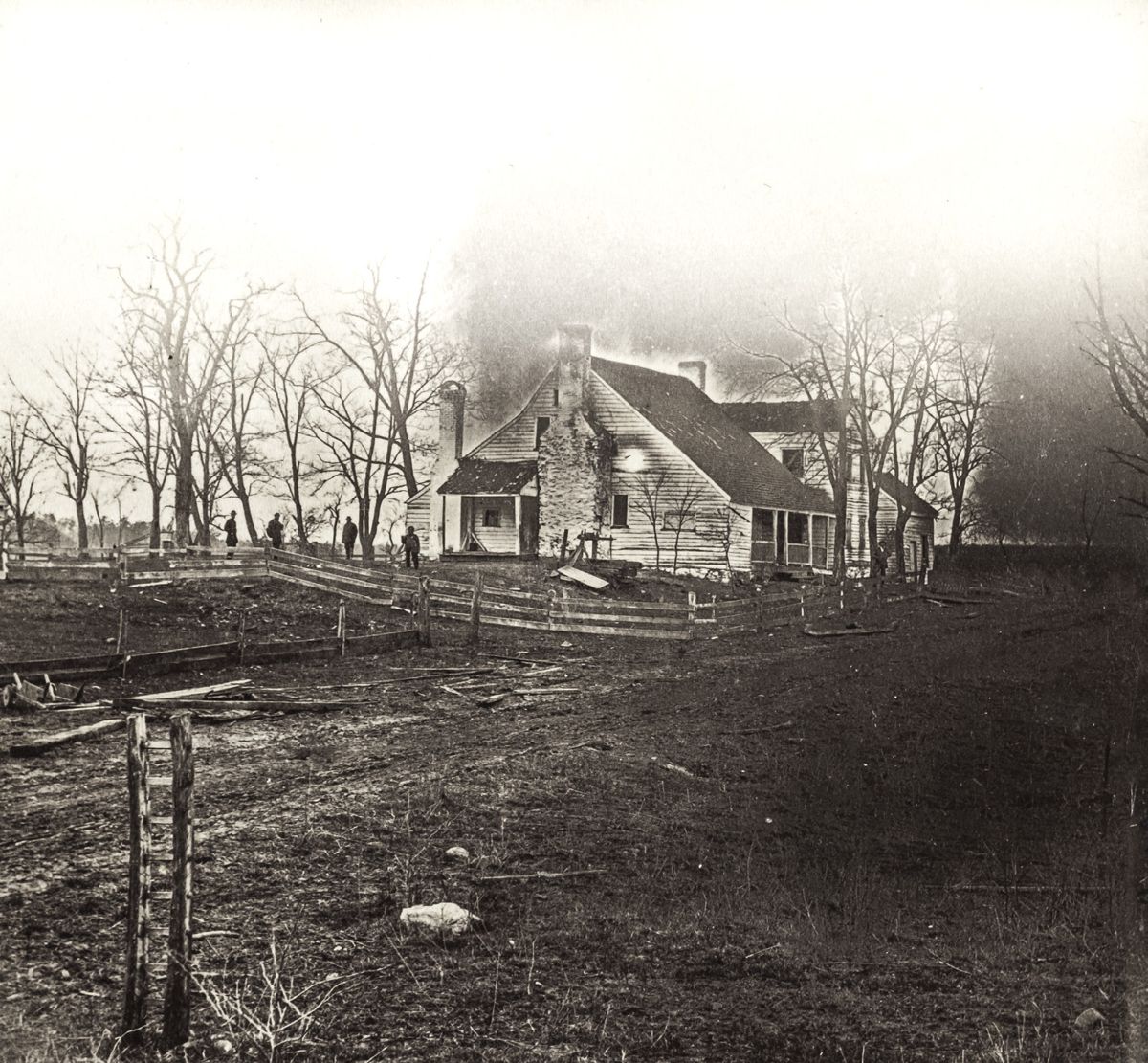
“Some was flung away, and some, I suppose, was stripped from the dead. Any number of families jest lived on what they got from the Union armies in that way. They’d pick up what garments they could lay hands on, wash ‘em and sell em.” Like others, Trowbridge could not help but notice the battle damage and discarded military debris. “A growth of saplings edging the woods had been killed by musketry: they looked like thickets of bean poles. The ground everywhere, in the fields and in the woods, was strewn with rotting knapsacks and haversacks, battered canteens and tin cups, and fragments of clothing,” he noted. Trowbridge’s driver pointed out places with high weeds and holes dug in the ground. The driver explained that the high weeds were where horses and men were buried. The holes are where bones had been dug up for the fertilizer factory that was in Fredericksburg. When Trowbridge asked if human bones were sent to the factory, the driver thought not, “unless by mistake. But people a’n’t always very particular about mistakes if thar’s money to be made by.” The evidence of the furious fight continued to amaze Trowbridge: “The tree trunks pierced by balls, the boughs lopped off by shells, the strips of timber cut to pieces by artillery and musketry fire, showed how desperate the struggle had been,” he penned. Moorhead and Lt. Col. McCreary visited Chancellorsville about three years after Trowbridge and a year after C. On the Nine Mile Run portion of the battlefield that CVBT has saved, they came to a row of earthworks where McCreary was captured as a prisoner of war. “The earthworks were still quite complete, although somewhat washed by rain. They lay directly across the road, and extended on either side into the deep woods,” Moorhead explained. Nearby, “Remains of uniforms, cartridge boxes, canteens, haversacks and some human bones lay in the trenches.” All around them, “Dead branches were hanging on all the trees, and all the [trunks] of them were scarred with shot and shell.” During a brief stop, while they used the earthworks for a place to sit, McCreary, who fought as part of the Second Corps, related his Chancellorsville memories. Around them were numerous Confederate graves “marked with head and foot stakes, the pencil tracings obliterated and a tangle of second growth covering them.” Moorhead “cut a hickory walking stick that had grown right out of the breast of some brave fellow. . . .” On they wandered to the ruins of the Chancellor House. Moorhead thought Chancellorsville was a bit Several post-war visitors mention stopping at Rev. Melzi Chancellor’s of a misnomer, as he wrote, “There home, also known as Dowdall’s Tavern. (Library of Congress) was no village here, nothing but this A correspondent going by the pen name “C,” who wrote for the Manchester, New Hampshire, Weekly Union, visited Chancellorsville in September 1867. Apparently still unmarked in any way at this time, C visited the site of Jackson’s wounding. “Of course every visitor to the battlefield seeks the spot,” he noted and described it as being “a few feet from the road, in some low, dense bushes.” Even four years after the battle, “Haversacks, cartridgeboxes, old shoes, tin cans, and other paraphernalia of war are seen at every step,” noted C. Stopping at Rev. Melzi Chancellor’s house (also known as Dowdall’s Tavern) which was Gen. O.O. Howard’s headquarters, he learned that Chancellor was not at home. However, C found the “family exceedingly courteous and obliging. They shared several stories about their Civil War experiences with him, leaving him empathetic with their ordeals. One of the advantages of reading these visitors’ accounts is what one can learn from the many conversations that occurred during their travels and that they share in their writings. Most people that travelers encountered were forthcoming in giving their opinions to a stranger they probably assumed they would never see again. Trowbridge also visited Chancellorsville. To do so, he hired what he thought was a buggy and driver, but turned out to be a one-horse wagon with a broken-down beast of burden. His driver explained that he made money the previous winter selling battlefield clothing. He explained,
Mine Run
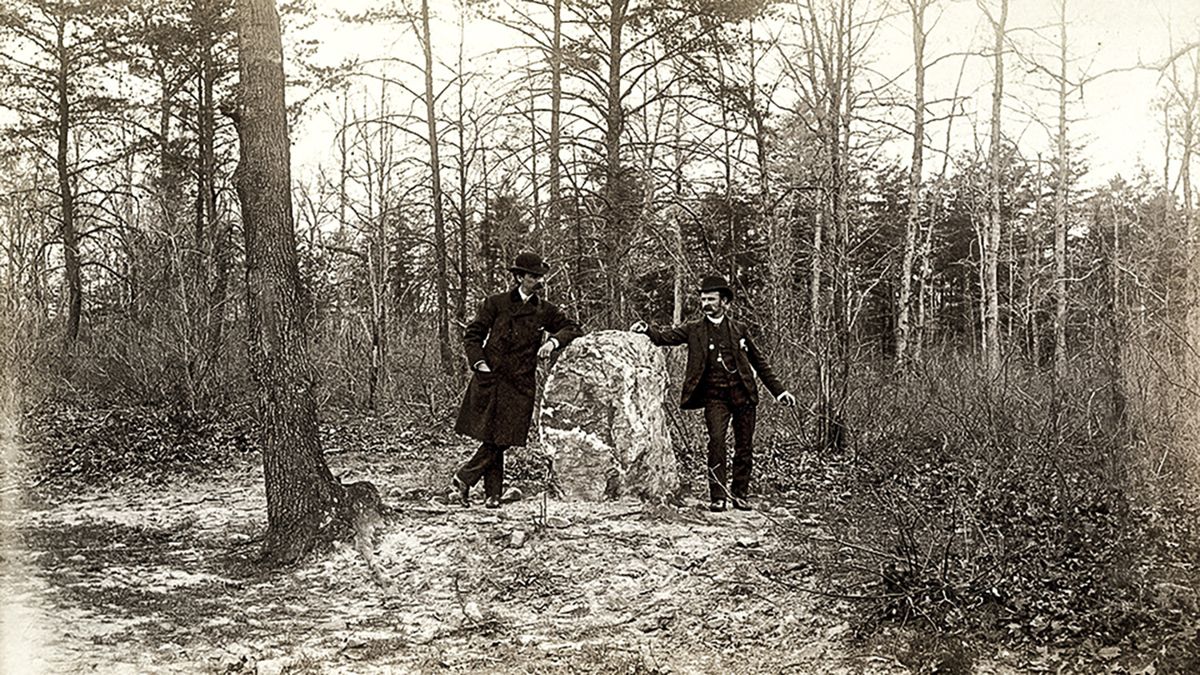
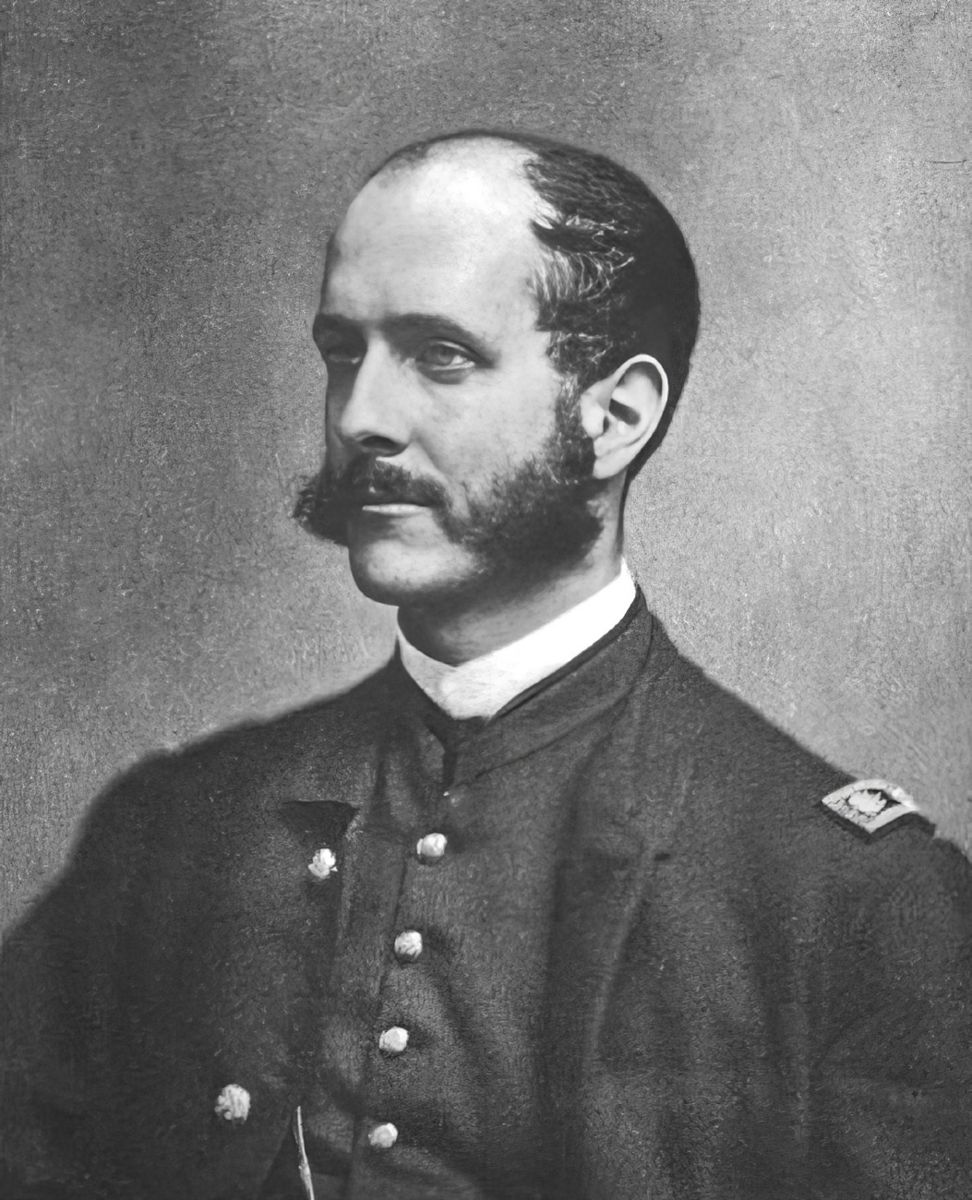
Almost a year after Lee’s surrender to Grant at Appomattox, Lt. Col. Theodore Lyman, Maj. Gen. George Meade’s aide-de-camp, revisited some of the Army of the Potomac’s old stomping grounds. To Lyman, who had been here before, “the country was full of interest to me.” Traveling from Washington, D.C., to Culpeper by train and then switching to horseback to cross the Rapidan River at Somerville Ford, Lyman and his party made their way to Verdiersville. Continuing east, and traveling on “the Orange Pike, which ancient thoroughfare is even in worse order than when marched The approximate site of Gen. Thomas J. “Stonewall” Jackson’s up it at Thanksgiving 1863,” they wounding was a popular attraction for early visitors at approached Mine Run. Chancellorsville. (Public domain) Lyman and company came up behind the Confederate earthwork one house.” Standing on the front porch steps, Moorhead line at Mine Run. He wrote, “and a stout line it was with painted a picture with his words. “An open plain all about thick embankment and great traverses all reveted with the house in every direction, then a dense, dark mass of large oak logs. . . .” Working on the logs, splitting them into jagged and stunted pines and scrub oaks as close together fence rails, was a local man, a former soldier in James L. as it is possible for them to grow. . . .” Roads radiated Kemper’s brigade, who apparently after a taste of fighting around the house. They “faced a road leading to Catherine had asked for and received a detail as an ambulance driver Furnace,” the Turnpike and Orange Plank Roads ran to as his contribution to the Confederacy. Fredericksburg to the left, “to the right, and near Melzi Chancellor’s [Dowdall’s Tavern] (which is about a mile west,)” the roads split again. Before moving on, Moorhead picked up a round musket ball. Like C, the visiting pair stopped at Melzi Chancellor’s house. Not home again, they talked with Mrs. Chancellor before viewing Wilderness Church, Jackson’s wounding site, and Catharine Furnace. In doing so, they wound up their sightseeing with a ride through Fairview, “the scene of the principle fighting” on May 3, 1863. Among the many latter-day battlefield visitors, veterans often wished to return to familiar places. In 1886, Corp. J.C. Riley, 1st Massachusetts Infantry, came back to Chancellorsville and “readily found the spot where I was captured. The two saplings between which I had twisted the barrel of my musket . . . had grown to be as large as my thigh. . .” A quick look around showed the ground “still strewn with such debris . . . belt plates, buttons and the other iron portions of a soldier’s kit, and under the fallen leaves I found more than fifty bullets in a search of less than ten minutes,” he noted. Riley also visited the site of Jackson’s wounding, which was near one of the positions where his regiment fought. By the time of his visit, a crude monument had appeared. There, “in an angle of the two roads” stood “a bowlder about 4 ½ feet high; its other dimensions are about 2 ½ feet either way. It is a common quartz, brought there by a Fredericksburg gentleman.” Riley explained that locals told him it did not mark the exact location where Jackson Lt. Col. Theodore Lyman wrote letters in the received his wounds. spring of 1866 describing some of the scenes at Mine Run. (Pubic domain)
Moving on, Lyman rode over Mine Run and “up on the opposite slope until we came to our line, which amounted to nearly nothing.” Looking back on late November and early December of 1863, Lyman remembered “that awfully cold weather,” and now fully understood “what fit we would have got had we tried to charge [the Confederate defenses]!” The following familiar site for Lyman was Robinson’s Tavern, where back in 1863, “we halted and built a big fire in the lower room, while the infantry were getting past” and into their positions. Up ahead were more memories as, “All this while, you comprehend, we were nearing the great field of the Wilderness which lies east of the Mine run region,” Lyman explained. In Part II follow-up, we will examine early battlefield visitors’ experiences at the Wilderness and Spotsylvania Court House. Tim Talbott is the Chief Administrative Officer with
the Central Virginia Battlefields Trust.
The mission of CVBT is to preserve land associated with the four major campaigns of: Fredericksburg, Chancellorsville, Mine Run, and the Overland Campaign, including the Wilderness, and Spotsylvania Court House. To learn more about this grassroots preservation non-profit, which has saved nearly 2,000 acres of hallowed ground, please visit: www.cvbt.org.
Collector’s Arms 1700-1945 Militaria Specializing in Civil War-World War II
9150 John S. Mosby Hwy. (Rt. 50) Upperville, Va 20185 for US Mail: PO BOX 602 (540) 592-7273 • [email protected]
Custom Made
Civil War Muskets
John G. Zimmerman Master Gunsmith 1239 Washington St. PO Box 1351 Harpers Ferry, WV 25425 (304) 535-2558 [email protected] johnzimmerman.website3.me
Subscribe or Renew online at CivilWarNewsMagazine.com Civil War Recreations HISTORIC MEDAL RECREATIONS
Gun Works, Inc. An American, Family-Owned Company Dixie Gun Works is proud to be an American small business success story. From humble beginnings in 1954, we have grown to be the largest supplier of blackpowder shooting equipment, parts, and antique guns in the world, and the most trusted name in blackpowder expertise. Find everything blackpowder you need here in the 2025 DIXIE GUN WORKS catalog.
Cordura® Sword, Saber & Musket Cases (US/CS/GAR/USA/Templar & Current Military) GAR Medal Replacement Ribbons & Uniform Accessories
ORDER TODAY! ONLY $8.00 PROFESSIONAL SERVICE AND EXPERTISE GUARANTEED VIEW ITEMS AND ORDER ONLINE!
www.dixiegunworks.com Major credit cards accepted
FOR ORDERS ONLY (800) 238-6785
DIXIE GUN WORKS, INC. 1412 W. Reelfoot Avenue PO Box 130 Union City, TN 38281 INFO PHONE: (731) 885-0700 FAX: (731) 885-0440 EMAIL: [email protected]
1 Smithbridge Rd, Unit 61 Chester Heights, PA 19017-4002
610.558.2163 or [email protected]
Photographs from the Original Article


Captions and credits appear in the article text as originally printed.