
Wyse Fork
By Larry Babits · Originally published July-August 2025 · pp. 14–17

Battlefield Anniversary By Larry Babits
Over the March 8 weekend, the Historic Preservation Group presented a two day tour of the recently protected battlefield of Wyse Fork. In actuality, three engagements took place on the sites east of Kinston, North Carolina. The first was a brief 1781 skirmish when county militiamen attempted to stop British raiders heading for New Bern. The British just shrugged off the local force. Then, in 1862, a Union column moved through the area as part of an attempt to interdict Robert E. Lee’s Army of Northern Virginia supply line from Wilmington by destroying railroad infrastructure at Goldsboro. The last Yankee visit occurred in March 1865 when a Union division attempted to break through Confederate lines protecting Goldsboro and Kinston to resupply Sherman’s Army. The attempt caused a four-day battle, the second largest in North Carolina. It also marked the last large scale capture of Federal troops.
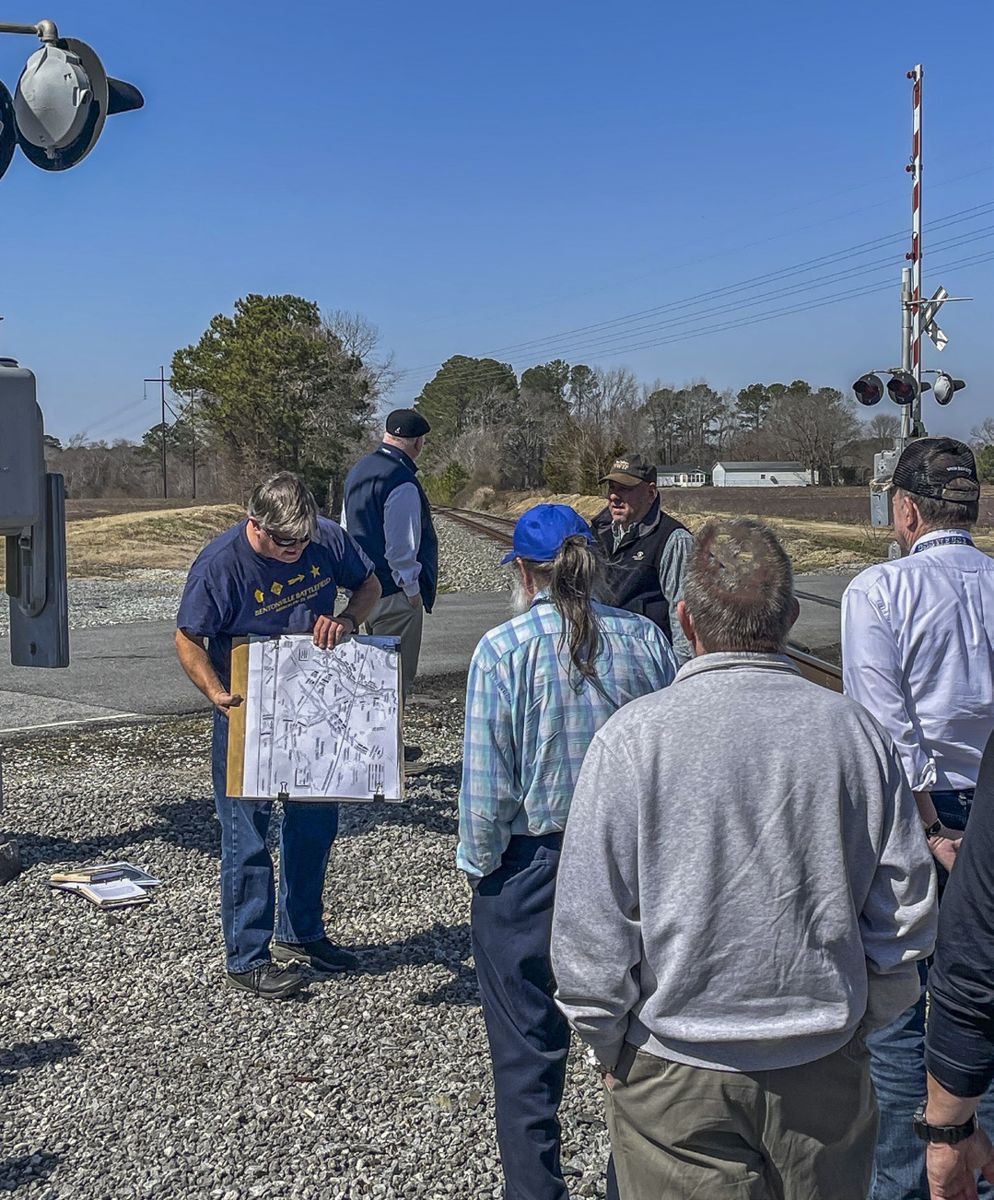
Presentation on landscape where Kirkland’s assault failed. Building in center background mark the crossroads. (Skip Riddle)
Unlike many anniversaries, the Wyse Fork event did not include a reenactment. Coupled with the battle’s anniversary were two other celebrations. The CSS Neuse Museum celebrated its tenth anniversary after renovating exhibits in downtown Kinston. The other focal point was the successful defense of a major component of the battlefield recognized by the North Carolina Department of Transportation agreeing to relocate an intersection planned for Wyse Fork that was to be positioned on the precise areas that saw the heaviest fighting in 1781 and 1865. Widespread opposition generated support from the American Battlefield Trust and other preservation groups that began acquiring endangered land to create a protected zone for posterity. There were many historical aspects to the battle that aided the public response, it was not just a major military encounter. Among the soldiers were many fascinating stories about how soldiers
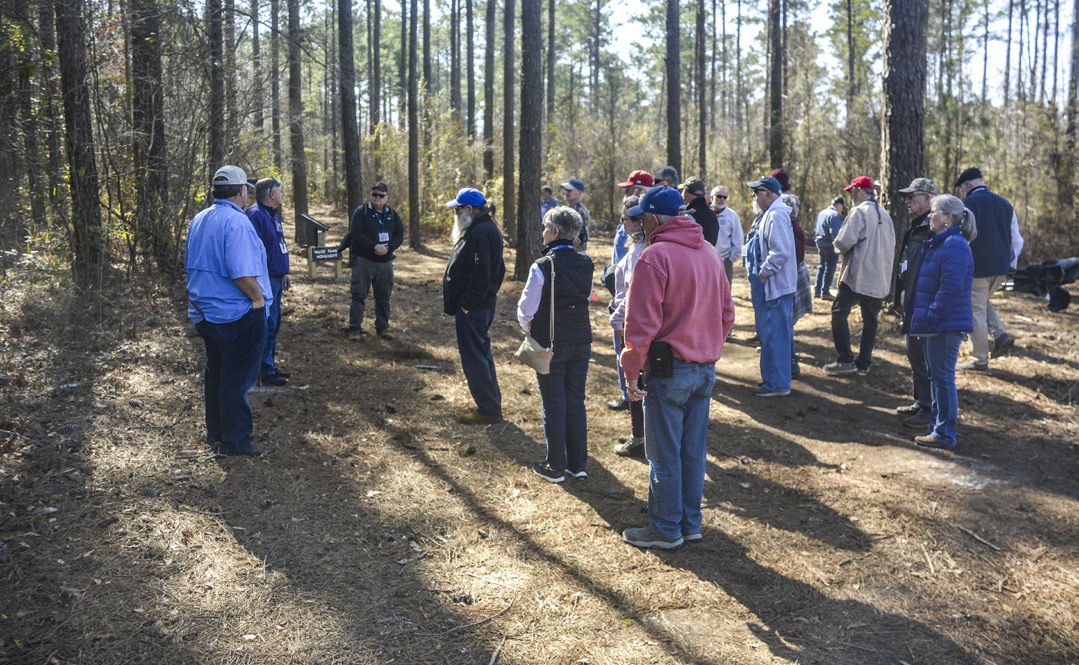
came to be at Wyse Fork. There were units from the North Carolina coast, a division from the Army of Northern Virginia, the Savannah and Charleston garrisons, and the remnants of the Army of Tennessee. Tuscarora soldiers in one Union regiment found themselves fighting on their ancestral homeland. Local men in Confederate regiments fought on neighbors’ land to defend Kinston. These stories were presented as vignettes during a lantern tour over part of the first day’s landscape. The walk began with an orientation to the first day’s fighting then went along a rough wooded path where interpreters portrayed battlefield characters along with a few Kinston Civil War legends.
The lantern walk began by meeting 42nd North Carolina Infantryman Tom Dula who was captured at Wyse Fork. He returned home and he was hung after the war for murdering Laura Foster. His story is fairly well known because a ballad was sung about the episode. The guide transitioning the group to the next vignette was Laura Foster cleverly enhanced by blacklights along the trail to appear especially ghostly. The visit with Union Army railroad engineer William Wright, assigned by Sherman to rebuild the tracks to Kinston, was near the original roadbed where, surprisingly, a modern freight train came through as the engineer explained his task. Lenoir County’s Colonel John Nethercutt served as a guide to Confederate units during the battle and explained how they found their way into attack positions that overwhelmed an advance Union party. A sailor from the CSS Neuse added information about the Confederate ironclad’s artillery fire supporting their infantry. A North Carolina artillery battalion commander, Lt. Col. Joseph B. Starr stood by a 12-pounder as he explained how they were manning a long trench line. In the woods, men could be heard felling trees, and sharpening their limbs to create obstructions in front of the outer ditch. Other participants included several reminiscing soldiers, a Yankee reporter, and a surgeon at work in a makeshift field hospital. The tour only covered some 300 yards but in the
Wade Sokolosky detailing a battlefield episode. (Larry Babits)
We Buy and Collect Rare Confederate and Southern Obsolete Currency.
Since 1978, we have collected or handled over 80 of the “Big Six” Confederate Notes to include nearly 10% of all known surviving Montgomery Notes.
Greg Ton
Wade Sokolosky explaining episode on Union Right flank. Railroad is on 1865 rail bed. (Skip Riddle)
901-487-5944 • [email protected] • Franklin, TN
GregTonCurrency.com
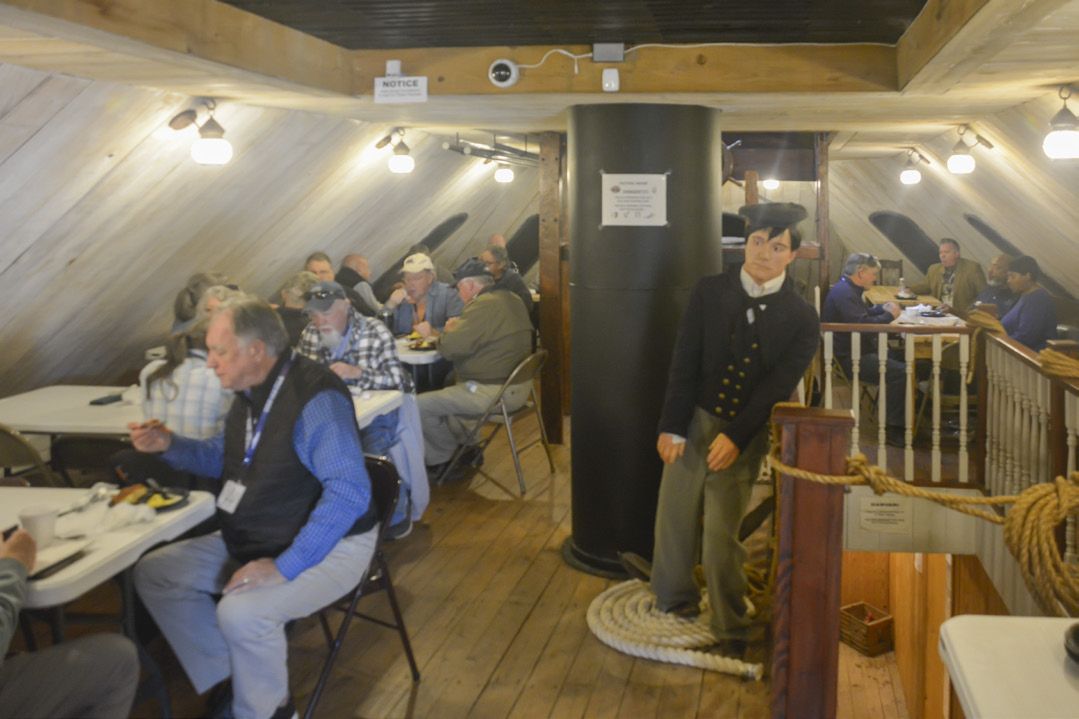
dark interpreters stood alone in the night with their thoughts. It ended with supper at the “Billy Yank and Johnny Reb Commissary” where participants were provided with a very filling meal based on eastern North Carolina BBQ with all the trimmings. Saturday’s activities began with breakfast aboard the reproduction CSS Neuse and orientation focusing on the battle’s last two days. Buses then took everyone to numerous stops where key battle events had taken place. Since the landscape has not changed very much, everyone could see where events being discussed occurred. At no place was this more vivid than standing in the wake of Kirkland’s attack against what was thought to be the Union flank. From the Union position, the land appeared flat, but Southerners were facing an uphill climb in the open against entrenched infantry and artillery. This attack turned out to be a disaster as the Federal lines had been extended, then reinforced with
Breakfast aboard CSS Neuse. (Larry Babits)
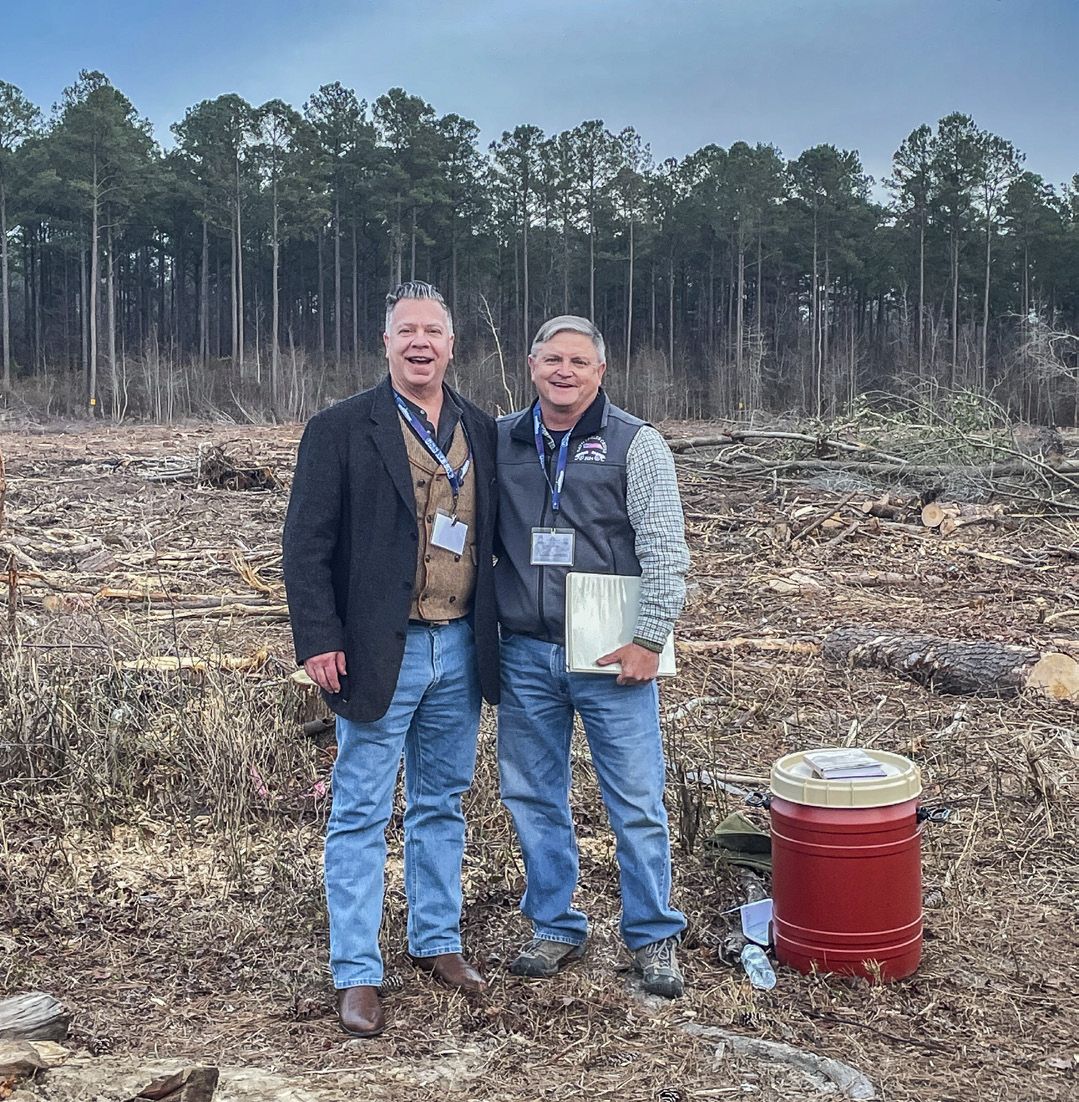
Wade Sokolosky and Chuck Laudner, American Battlefield Trust. (Skip Riddle)
Map of battlefield core and study areas. The Study Area encompasses the separate Federal routes of advance, the Confederate route of advance, and the areas of flank attacks made by both forces. The western edge of the Core Area was adjusted to include the location of an additional Confederate battery. (American Battlefield Protection Program)
both infantry and artillery. Kirkland’s men were caught in a firestorm as they advanced only to be cut down. Many descendants of battle participants contributed to the shared information and provided a sense of continuity for the tour group. The two leaders, Wade Sokolosky, author of THE book on the battle, “To Prepare for Sherman’s Coming”: The Battle of Wise’s Forks, March 1865, and Dennis Harper, an avocational archaeologist and descendant of men who fought in the battle, provided in depth explanations at each tour stop, then answered questions about other details posed by the group. The bus tour ended with another big lunch. A break allowed participation in the museum activities and touring the original Neuse. The evening began with another filling meal. After dinner, awards were presented to two long time advocates in historic preservation, Jane Phillips and Bill Rowland. Guests were then treated to a brilliant performance by southern agent, Rose O’Neal Greenhow, portrayed by Emily Lapasardi. The depth of Lapasardi’s knowledge about the life and trials of Maryland’s daughter of the South, captivated her audience from the first words about her participation in Washington’s high society where she entertained most dignitaries, including luminaries like John C. Calhoun, John Breckenridge, Edwin Stanton, and Daniel Sickles, adding asides about their idiosyncrasies and their indiscretions. Once the war broke out, she continued entertaining but with an aim to learn what the Lincoln government was doing so it could be forwarded to Richmond. She also described her imprisonment before she was exiled to Virginia. For a first time effort, this anniversary fete was remarkable for its variety and depth of information. There were a few hitches as expected for an opening effort. They were shrugged off just as the visitors dealt with cold and windy conditions.
STEADILY BUILDING A COLLECTION SINCE 1896 The Civil War artifact collection at the South Carolina Confederate Relic Room and Military Museum is unparalleled. Growing since 1896, it has doubled in the 21st century. The museum seeks to expand to showcase rare artifacts, including the Corky Huey and Colin J. McRae Archival Collections on European arms, as well as South Carolina-made weapons. Recent acquisitions include the Joseph Allen Edens Collection, featuring rare muskets, swords, and a frock coat. None are yet on exhibit, but can be viewed by appointment by calling 803-737-8095. 301 Gervais Street Columbia, SC
crr.sc.gov
47 th Southeastern
Annual
Free Parking!
Civil War & Antique Gun Show Antique Firearms up to WWII Aug. 9 & 10, 2025
Saturday 9–5 • Sunday 9–3 Cobb County Civic Center 548 S. Marietta Parkway, S.E., Marietta, GA 30060
Over 220 Tables of: • Dug Relics • Guns and Swords • New and Old Books • Frameable Prints
• • • • •
Inquires:
NGRHA Metal Detectors For table reservations, email Artillery Items Jim Hammonds at Currency [email protected] Belt Buckles Bullets and Cartridges Admission: $8 for Adults
Veterans & Children under 10 Free
Photographs from the Original Article


Captions and credits appear in the article text as originally printed.