
THE UNFINISHED FIGHT:
By Craig L. Barry · Originally published September-October 2024 · pp. 8–10
To be introduced by someone meant they were vouching for your character, which also put that person’s own reputation at risk. For this reason, the formalities of introduction and acquaintance were taken very seriously. When a woman was being introduced to a new male acquaintance, would she offer her hand to be polite? It depends…on introductions taking place inside a room, a married lady generally offers her hand, but a single girl would not. However, in a ballroom setting, where an introduction is made to ask for a dance, not friendship, a gentleman would not initiate contact or shake hands with a lady, only bow. “It may perhaps be stated that the more public the place of introduction, the less touching takes place.” What were the reasons for this degree of formal etiquette? To a woman of the 1860s, a spotless reputation was the first priority. Someone of dubious character was shunned
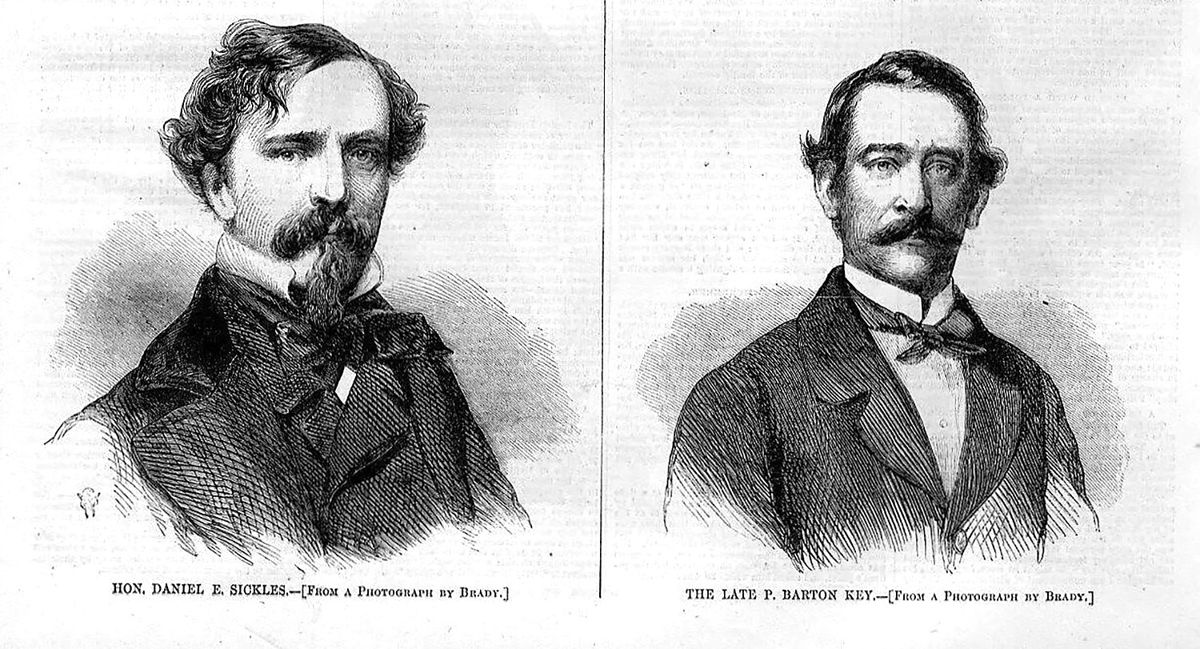
Hon. Daniel E. Sickles and the late P. Barton Key.
completely by the rest of “society.” The double standard was best exemplified by the case of that well-known rake, Congressman Dan Sickles, the self-proclaimed hero of Gettysburg’s Peach Orchard. Dan Sickles’ pre-Civil War career was full of personal scandals. He was censured by the New York State Assembly for escorting a well-known prostitute into its chambers. He also reportedly brought that same prostitute to England with him to meet Queen Victoria, leaving a pregnant wife half his age at home. Speaking of his wife Teresa, Sickles had married her against the wishes of both families, and, in an ironic twist with tragic consequences, his lack of fidelity came back in his face when his young wife became involved in an illadvised affair with Philip Barton Key II, the son of Francis Scott Key, who wrote “The Star Spangled Banner.” Far from forgiving, upon learning of his wife’s indiscretion in 1859, the enraged Sickles summarily shot and killed Philip Key in the streets of Washington, D.C., allegedly in front of the White House. As for Philip Key, besides being the son of someone famous and beloved, he was perhaps more importantly, the U.S. Attorney for the District of Columbia. Now here was a scandal, even by Washington standards. Congressman Sickles was charged with murder but subsequently acquitted after a sensational trial involving the first use in U.S. jurisprudence of temporary insanity as a legal defense for murder. His defense attorney was well chosen, none other than Edwin M. Stanton, later to become Lincoln’s Secretary of War. After this incident, the
Washington for some time. Mr. Key was shot near the Pres. House by a member of the House of Representatives from the State of New York.”
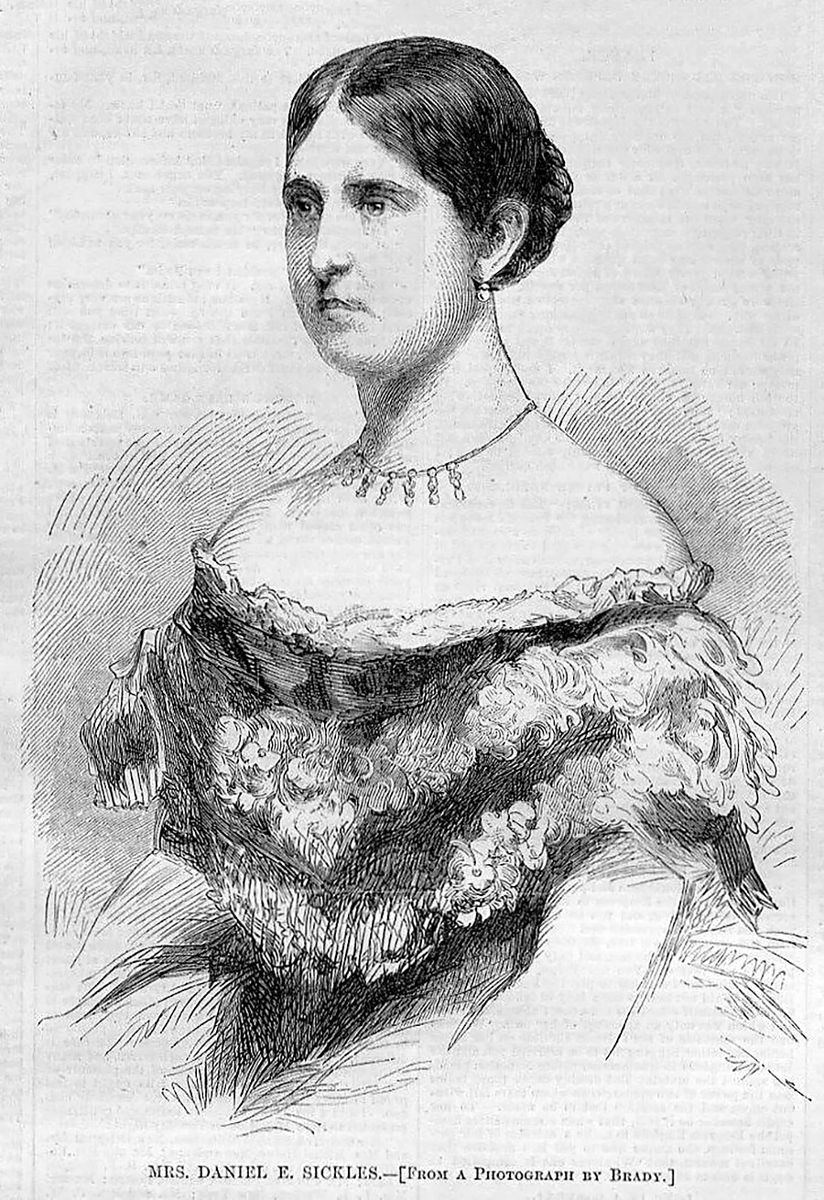
Teresa Sickles.
notorious Dan Sickles did not even lose his congressional seat. The attitude of the general public was much more hostile toward Sickles after his later reconciliation with his wife than it was to the murder of Key or even Sickles’ numerous other scandals including his unorthodox legal “defense.” However, his wife Teresa was never forgiven and formally shunned by Washington society ever afterwards, the love affair apparently being the more serious of the two crimes. The only complaint about Sickles’ behavior (generally) was that he took his wife Teresa back. Aldrich’s diary, for February 28, 1859, he wrote: “Monday has been quite a great day for Washington the shooting affair last evening was the most wicked a thing that was now done in
Aldrich’s diary entry for February 28, 1859.
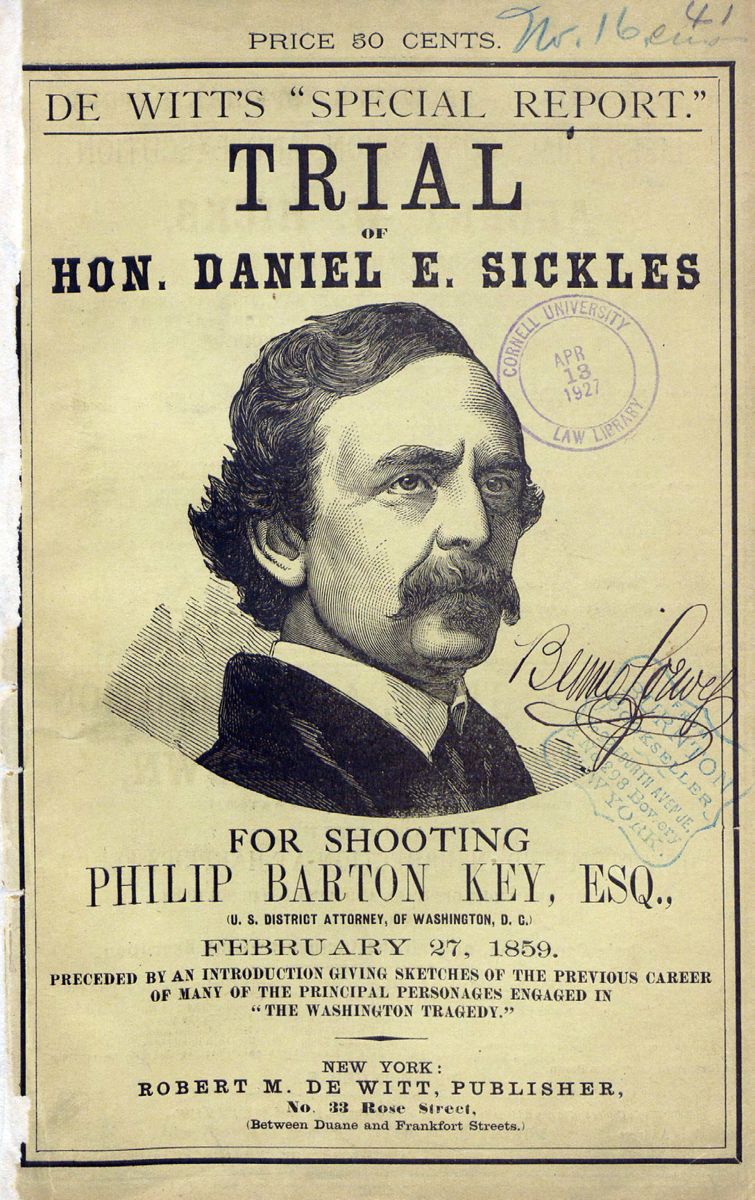
De Witt’s “Special Report.” Trial of Hon. Daniel E. Sickles For Shooting Philip Barton Key, Esq.
The point here is there was no middle ground for a woman in the 1860s. They were either virtuous, or a trollop. Another example of behavior being modified by threat of a soiled reputation, justified or not, were the famous Orders # 28. One major problem confronted by Maj. Gen. Benjamin F. Butler, on his occupation of New Orleans in April 1862, was the abuse his soldiers endured from the female civilian residents of the city. It was noted that “Bitterly resentful of the Union occupation, whenever any of Butler’s men were present they would contemptuously gather in their skirts, cross streets, flee rooms, cast hateful glances, or make derisive comments. Some sang spirited renditions of “The
Bonnie Blue Flag” and other Confederate songs, or spat on soldiers’ uniforms, while teaching their children to do the same. One woman emptied a chamber pot on Capt. David C. Farragut from her window shortly after the Mayor of New Orleans surrendered the city. The women hoped their actions would force a retaliatory incident serious enough to incite paroled Confederate men to revolt against the occupying Federal troops in New Orleans.” Butler’s men showed admirable restraint against the insults, but he knew that it was only a matter of time until one soldier, pressed too far, would confront or arrest some female belligerent and incite a riot from a mob made up of irate and impassioned gentlemen of the city. Butler feared that his small occupation force would be overcome by the outraged mob and that the matter would result in anarchy. He summarily dealt with the problem on May 15, 1862, by issuing General Orders No. 28, carefully worded to stop dead the insults to his men: General Orders, No. 28 HDQRS. DEPARTMENT OF THE GULF, New Orleans, May 15, 1862. As the officers and soldiers of the United States have been subject to repeated insults from the women (calling themselves ladies) of New Orleans in return for the most scrupulous non-interference and courtesy on our part, it is ordered that hereafter when any female shall by word, gesture, or movement insult or show contempt for any officer or soldier of the United States she shall be regarded and held liable to be treated as a woman of the town plying her avocation. By command of Major-General Butler: GEO. C. STRONG, Assistant Adjutant-General and Chief of Staff Except for a few isolated incidents this plan worked very well, and when the ladies of New Orleans learned they would be subject to arrest as vagrants or prostitutes and thus branded as dishonorable just for the act of demeaning a man wearing a U.S. army uniform, the insults stopped abruptly. Psychologically, the reason this worked was due to the potential for absolute destruction to their reputation which could result from even the perception of dishonor. For example, any arrest of this sort could mean the unfortunate women might never marry someone from same social register, or be able to get one of the few decent jobs available such as schoolteacher or nurse; if she was already married her husband was expected to throw her out or at least live apart from her…send her away. Butler made the insulting behavior no longer worth the potential social cost to the ladies of New Orleans. He achieved a nearly complete surrender based solely on the societal pressure of etiquette without any further action. Well, almost…one Mrs. Eugenia Levy Philips of New Orleans, wife of a former congressman from Alabama and mother of nine, already pardoned once, earned herself a 90 day sentence at Shipp Island with other Confederate prisoners in July 1862 for standing on her balcony and shouting disparagements at a Union funeral procession passing by. When confronted with the facts in court, she stated “Yes, I was in good spirits that day.” Technically, the charges were not pressed as stated in General Orders 28, “being a woman of the town plying her avocations,” but rather the complaint was in the legal realm of disorderly conduct “…acting as a dangerous woman, stirring up strife and inciting a riot.” Few others followed her example, and after her release from prison the notorious Mrs. Philips with her husband and brood moved to LaGrange, Georgia, for the rest of the war. Her husband, Philip Philips practiced law in Washington, D.C., after the war but never achieved as much in his political career as he might have otherwise because of the “unrestrained activities of his wife.” Even the stalwart Confederate patriot Mary Chesnutt noted in her diary that Mrs. Philips was “a bad, mad woman.” American society in the 1860s was extremely concerned with the maintenance of proper standards for both men and women, but particularly women. Hence, we can see that the “rules” of behavior were very different for women of the Civil War-era than for men. Men would have been well aware of this double standard unless they were terribly stupid or socially backward. In conclusion the goal is to base any portrayal of 1860s behaviors on the existing documentation of the manners of the time period. The surviving record strongly suggests that tipping your hat to a lady on the street who is a total stranger and saying “Good Morning, Ma’am” or almost anything else would cause her to potentially be seen as less than honorable and set tongues wagging. People would gossip endlessly about the circumstances of your greeting, assume there was a prior acquaintance, and depending on who witnessed the exchange it could be very damaging. For example, it raises several questions beginning with, “How does she know those soldiers?,” which leads to “Has she been out to their camp?,” and then logically to speculation on “What was she doing there?” inferring nothing good and so on. Hence, this common greeting would only be initiated by the man if he wanted to cast doubt on the woman’s character for some reason, or to show himself to be uncouth and crude. To demonstrate the proper respect expected of a Southern gentleman, he would wait for a cue from the woman to whom he wished to speak and never initiate even polite conversation with female strangers in the street. Craig L. Barry was born in Charlottesville, Va. H e holds his BA and M asters degrees from UNC (Charlotte). Craig served The Watchdog Civil War Quarterly as Associate Editor and Editor from 2003– 2017. The Watchdog published books and columns on 19th-century material. He is the author of several books including The Civil War Musket: A Handbook for Historical Accuracy (2006, 2011), The Unfinished Fight: Essays on Confederate Material Culture Vol. I and II (2012, 2013). He has also published four books in the Suppliers to the Confederacy series on English Arms & Accoutrements, Quartermaster stores and other European imports.