
Burnside’s Invasion of East Tennessee Financing the Civil War:
By Gould Hagler · Originally published November-December 2024 · pp. 24–27
&
Tragedies and Statistics This & That By Gould Hagler
“A single death is a tragedy; a million deaths are a statistic.” – Joseph Stalin
Joseph Stalin, we all know, was responsible for mountains of statistics. As one reads about the Civil War, one encounters statistics that, though mere hillocks in comparison with Stalin’s mountains, are nevertheless measures of a long, destructive war and of the vast, wholesale volumes of human suffering it caused. This column, however, will not focus on statistics, but on some tragedies, battlefield deaths that are notable in that some of the chief mourners were not far away, but on the same battlefield. We start at Shiloh.
The Harris Clan
Tennessee’s governor, Isham Harris, remained in his capital less than one year after the start of the war. When Nashville fell in February 1862, Harris was forced into exile and joined the staff of Gen. Albert Sidney Johnston, serving as a volunteer aide.
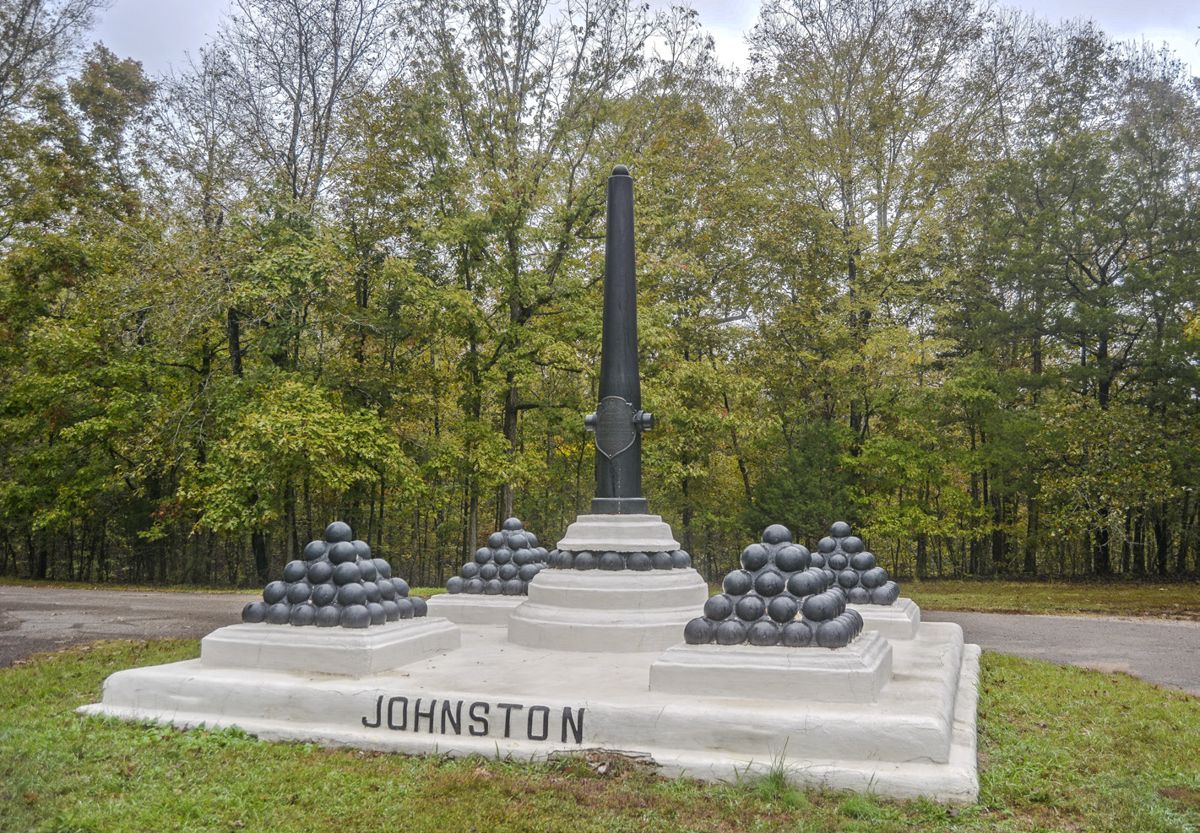
What happened on the afternoon of April 6 is wellknown. Rallying his wavering troops, General Johnston led from the front. A bullet nicked his lower leg. At first, Johnston was barely aware that he had been struck. When Harris inquired, the commander said he was unhurt and dispatched the governor/aide-de-camp to deliver an order to a nearby regiment. Harris returned minutes later to see the mounted general begin to swoon. Fearing Johnston would fall from the saddle Harris moved to support him. “General, are you hurt,” Harris asked. “Yes, and I fear very seriously,” Johnston answered.1 The nick on his lower leg had opened an artery. Johnston was bleeding to death. Harris and another aide helped Johnston to shelter in a nearby ravine, where the wounded leader soon lost consciousness and quietly died. Also present at this sad scene was Col. William Preston, the brother of Johnston’s late first wife. Less well-known than the tragedy of Johnston’s death is the further personal losses suffered that day by Isham Harris. As the governor was leaving the ravine to convey the news of Johnston’s death to General Beauregard, a rider approached, Harris’s nephew, bearing dreadful news from the Confederate left, where Lt. Col. James Harris’s Arkansas regiment was engaged. “Uncle Isham,” said the rider, “Father has just been killed.” More bad news would come later. Harris had another brother with a son fighting at Shiloh. “To compound the family’s loss,” wrote Harris’s biographer, “William R. Harris’s son John Clinton Harris was also killed in the battle.”2
The Brothers Forrest
Monument honoring General Johnston near the site of his death at Shiloh, Tennessee. (Gould Hagler)
If a person writing on the Civil War refers to “Lee,” without further specification, the reader knows the subject is Robert E. Lee. Similarly, a reference to “Forrest,” without a first name, tells the reader the subject is Nathan Bedford Forrest. However, just as the most prominent Lee was not the only Lee, Forrest was by no means the only Forrest. Like the Harrises, the Forrests knew tragedy in their War for Southern Independence. Nathan Bedford Forrest was the eldest of his parents’ six sons who survived to adulthood. Four of Bedford’s brothers were cavalry officers in the Confederate army. The fifth, disabled by a wound suffered in the Mexican War, also made a brief appearance in the conflict. (See sidebar.) Jesse Forrest commanded a new cavalry company which joined Bedford’s force in Nashville in February 1862, where Bedford was laboring to restore some level of order in a city thrown into a panic by the fall of Fort Donelson.3 Jesse, by 1864 a lieutenant colonel, participated in the raid on Memphis in August and led a detachment tasked with the job of capturing one of the three Federal generals Bedford hoped to bag. Jesse missed the general but did bag some staff officers and the general’s uniform.4 The following month Jesse suffered a severe, but nonfatal wound in the attack on Athens, Alabama.5 Another brother, William, a captain, also served in his older brother’s command. William was seriously wounded in April 1863 at Day’s Gap, as Bedford’s force chased Col. Abel Streight through north Alabama.6 William did recover, however, and was back in action in two or three months.7 Along with brother Jesse, William led a detachment in the Memphis raid, hoping to capture another of the generals in the town. William also missed his prey.8 Jesse and William recovered from their wounds. Two other Forrest brothers did not survive the war. In March and April 1864, Bedford led a raid into west Tennessee and Kentucky. Aaron, a lieutenant colonel commanding the 2nd Mississippi Cavalry, fell ill during the raid and had to drop out. He died of pneumonia in Dresden, Tennessee.9
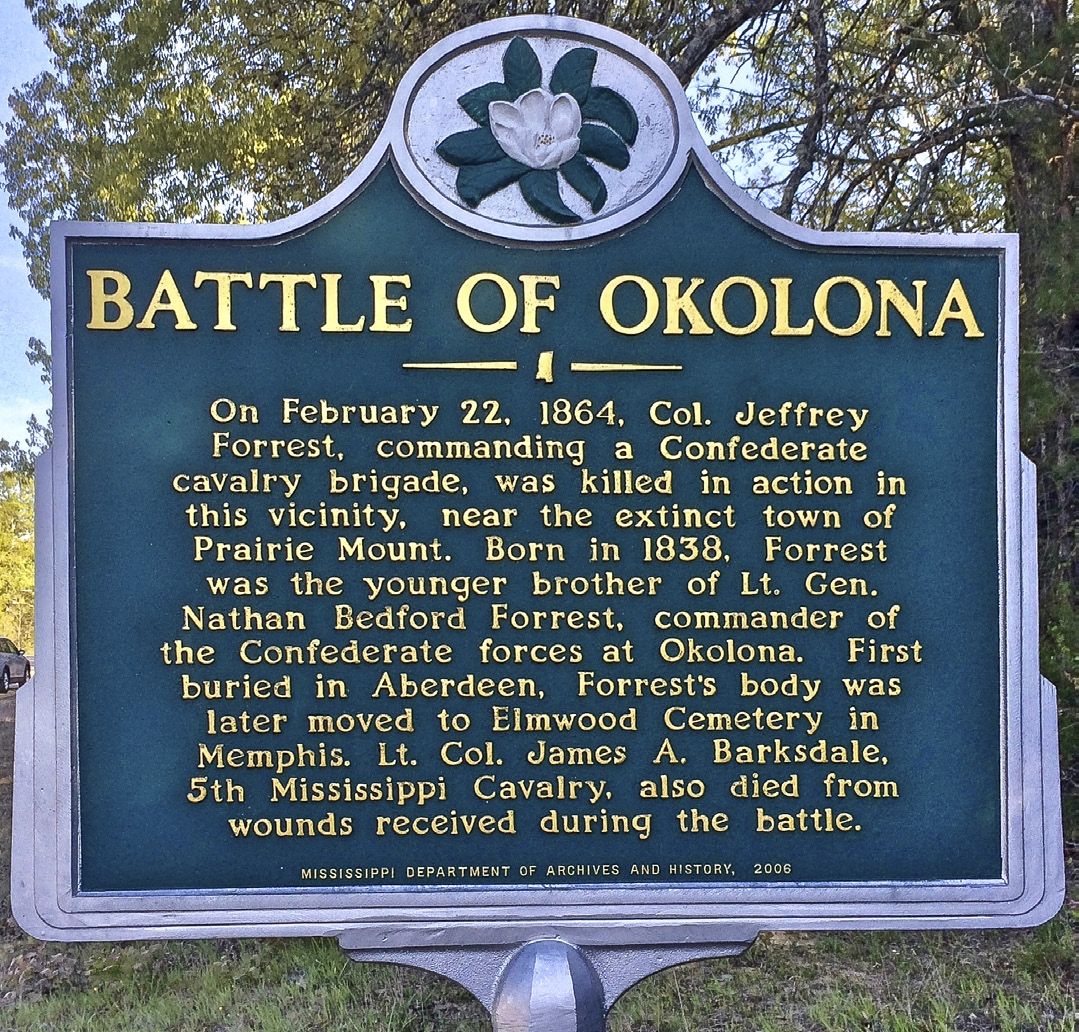
Battle of Okolona Marker. (Courtesy Mark Hilton, https://www.hmdb.org/m.asp?m=102744)
The Sixth Forrest Brother The five Forrest brothers who fought in the Civil War had a brother, John, who did not serve in the Confederate army. Though a civilian, John did have a violent encounter with a Federal officer. The story is found in Wyeth’s biography of John’s famous brother. “John Forrest…volunteered in the American army and served in the Mexican War,” Wyeth wrote, “and there received a gun-shot wound through the lower part of the spinal cord which produced complete paralysis from that point downward.” According to Wyeth, John thereafter “could neither walk nor stand without the aid of crutches.” John resided in Memphis and remained there after the Federals occupied the city in 1862. John’s mother, long a widow, living on a plantation located a few miles from town, was visited by a Federal officer and a detachment of men. As Wyeth phrased it, the men “had deported themselves in such a manner as to arouse the indignation of the mother of the Forrests.” Mrs. Forrest went to Memphis the next day and told her only available son what had happened. A day or two later, John confronted the officer “and called his attention to his conduct in the presence of his mother, and told him if he ever repeated the offence he would break his crutch over his head.” The officer did not take kindly to John’s threat and “began to abuse not only John Forrest but all the family in severe terms.” John, who was seated at this point, rose and tried to land a blow on the officer with one crutch as he balanced himself with the other. As John swung the crutch the officer grabbed it from the air and kicked the one with which the angry cripple supported himself. John, down on the sidewalk, pulled a derringer from his pocket and fired, hitting the officer and causing a grievous wound. The officer had a close call, but after a few weeks recovered. John was arrested, shackled in irons and imprisoned on a gunboat. The news reached his brother Bedford. The general “at once demanded of the general in command at Memphis the proper treatment or release of his brother until he could be tried by law for shooting the officer.” The general in Memphis complied with General Forrest’s demand. John was released and later was tried. He was acquitted.* * Wyeth cites no sources. A quick internet search produced different versions of this episode, or perhaps others that are similar. I am passing along the one I deem most interesting, which is not necessarily the most accurate.
Jeffrey was Bedford’s youngest brother, born in 1837, four months after their father’s death. Bedford was 16, nearly grown, and in Jeffrey’s life he played a father’s role as well as a brother’s. The youngest Forrest, a colonel, was wounded and captured in the Battle of Dover in February 1863. He was soon exchanged and returned to Bedford’s command. At the Battle of Okolona, fought in February the following year, Jeffrey was killed in action. Brian Wills wrote that Bedford “allowed himself only the briefest official notice of his intensely personal loss.” In his after-action report Forrest wrote that the death of his brother was “deeply felt by his brigade as well as myself, and it is but just to say that for sobriety, ability, prudence, and bravery he had no superior of his age.”10
The General’s Son
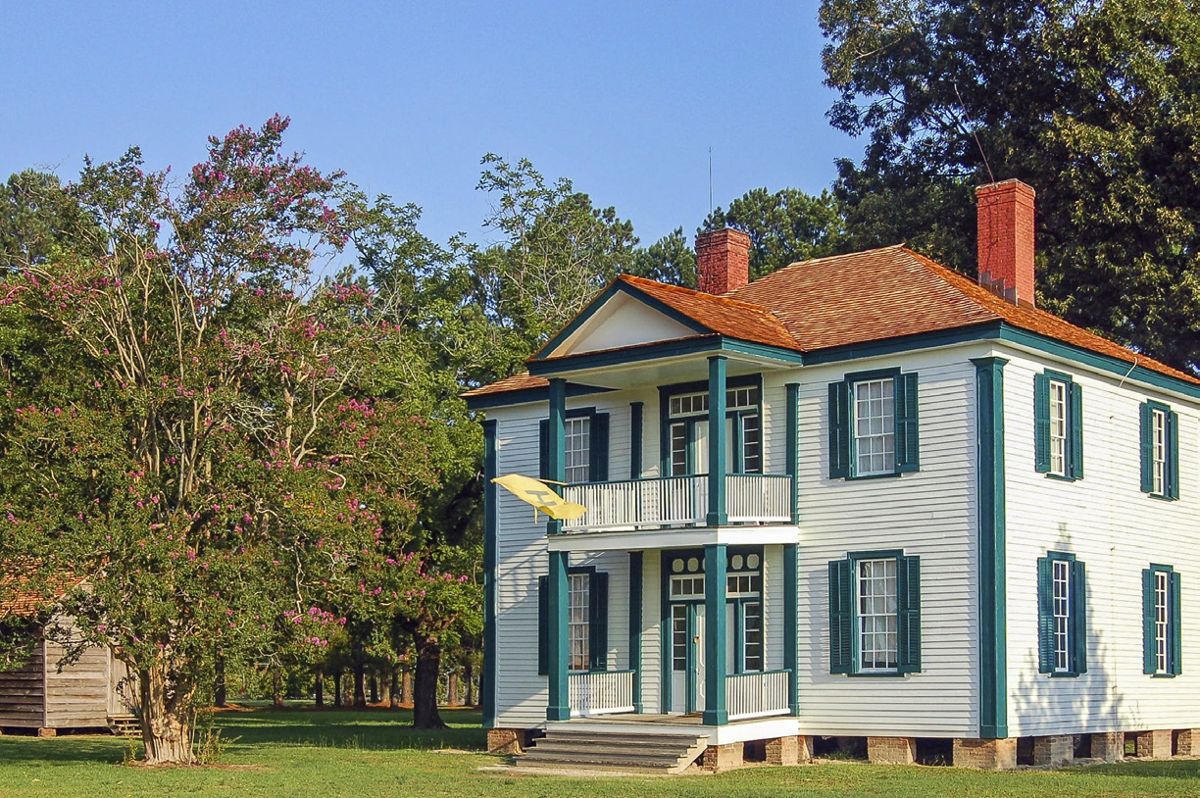
The Harper House at Bentonville served as a hospital
The last episode following this month’s theme after the battle. (Gould Hagler) is the sad story of a very young man mortally wounded in the final weeks of the war. wounded men were successfully evacuated. On the 23rd William J. Hardee, a native of Georgia, was a graduate Hardee rode from Smithfield to a private home in Hillsboro, of the U.S. Military Academy, class of 1838. He had where Willie was being cared for by his step-mother and his a successful career in the old army, rising to the rank aunt. Willie died the following day.11 of lieutenant colonel and serving as the Academy’s Governor Harris lost a close friend, a brother and a commandant of cadets from 1856 to 1860. Widowed in nephew at Shiloh. General Forrest lost his youngest brother 1853, he was the father of three daughters and a son, born at Okolona. A second brother died of disease after dropping in 1848. When his state left the Union, so did Hardee. He out of an earlier campaign. Two other Forrest brothers were resigned his commission in 1861. seriously wounded but survived. At Bentonville, General While Lt. Gen. Hardee commanded Confederate troops Hardee lost his only son, a mere boy, who insisted on in the Western Theater, his son Willie was where a boy his leaving school to join his father in battle on the very last day age belonged—in school. However, by 1864 the lad was the general led troops in combat. These are a small sample longing to leave school and serve his country. Willie signed of family tragedies that accumulated over four years to form up with Terry’s Texas Rangers, but when the regiment’s a great mound of statistics. colonel found out he sent Willie back to school. When the headmaster refused to take the lad back the colonel relented. Endnotes 1. Quoted in The Iron Dice of Battle: Albert Sidney Johnston and the He took Willie with him as he crossed Georgia to join the Civil War in the West, by Timothy B. Smith, p. 160 force assembling to block Sherman as he marched through 2. Isham G. Harris of Tennessee: Confederate Governor and United the Carolinas. There Willie joined his father’s staff as an States Senator, by Sam Davis Elliot, p. 111 aide. 3. The Confederacy’s Greatest Cavalryman: Nathan Bedford Forrest In eastern North Carolina on March 19-21, 1865, the by Brian Steel Wills, p. 66 Confederate’s cobbled-together army under Gen. Joseph 4. Ibid., p. 242 E. Johnston clashed with the Federals at Bentonville. 5. That Devil Forrest: Life of General Nathan Bedford Forrest, by The Confederates achieved some initial success, but as John A. Wyeth, p. 15 (Kindle Edition) Sherman’s forces concentrated, Johnston’s army faced 6. Wills, p. 112 7. OpenAI, Chatgpt, https://openai.com/chatgpt, accessed July 3, 2024 insurmountable odds. Johnston planned a retreat. 8. Wills, 242 When the Federals attacked on the 21st they threatened 9. Wyeth, p. 15; OpenAI, Chatgpt, https://openai.com/chatgpt, to cut off the Confederates’ only line of retreat. To protect accessed June 24, 2024 a vital bridge, Hardee led a counter attack, using the few 10. OpenAI, Chatgpt, https://openai.com/chatgpt, accessed June 24, available units, among them Terry’s Rangers. When the 2024; https://www.battlefields.org/learn/civil-war/battles/okolona; Rangers were called upon to charge the advancing Federals, Wills, p. 167; OR, 32, pt. 1, pp. 354-355 among their ranks was Willie Hardee, released from safe 11. The biographical information on Hardee and the account of the staff duty by his proud, but no doubt anxious father. The events at Bentonville are taken from General William J. Hardee: charge succeeded. The Federals were repulsed and the Old Reliable, by Nathaniel Cheairs Hughes Jr. avenue of retreat remained open. Hardee, the general returned from the charge unhurt; Hardee the private was carried back on a litter, critically wounded. The general Gould Hagler is a retired lobbyist living in spent a brief time with his injured son, then turned his Dunwoody, Ga. He has been a regular contributor attention to his command duties. to CWN since 2016. He can be reached at gould. As the army retreated to safety, Willie and the other [email protected].
&