
This & That 46th Year!
By Gould Hagler · Originally published July-August 2024 · pp. 30–38
& T
Supplying Gunpowder to the Confederate Army This & That By Gould Hagler
“The appalling contemplation of the inauguration of a great war, without powder or a navy to secure its importation from abroad, was soon relieved.” – Jefferson Davis hese words of Jefferson Davis were written in The Rise and Fall of the Confederate Government, published in 1881. The following year Col. George Washington Rains1 said something very similar, notable in his use of the same adjective, “appalling.” “The entire supply of gunpowder in the Confederacy at the beginning of the conflict, was scarcely sufficient for one month of active operations,” Rains said, “and not a
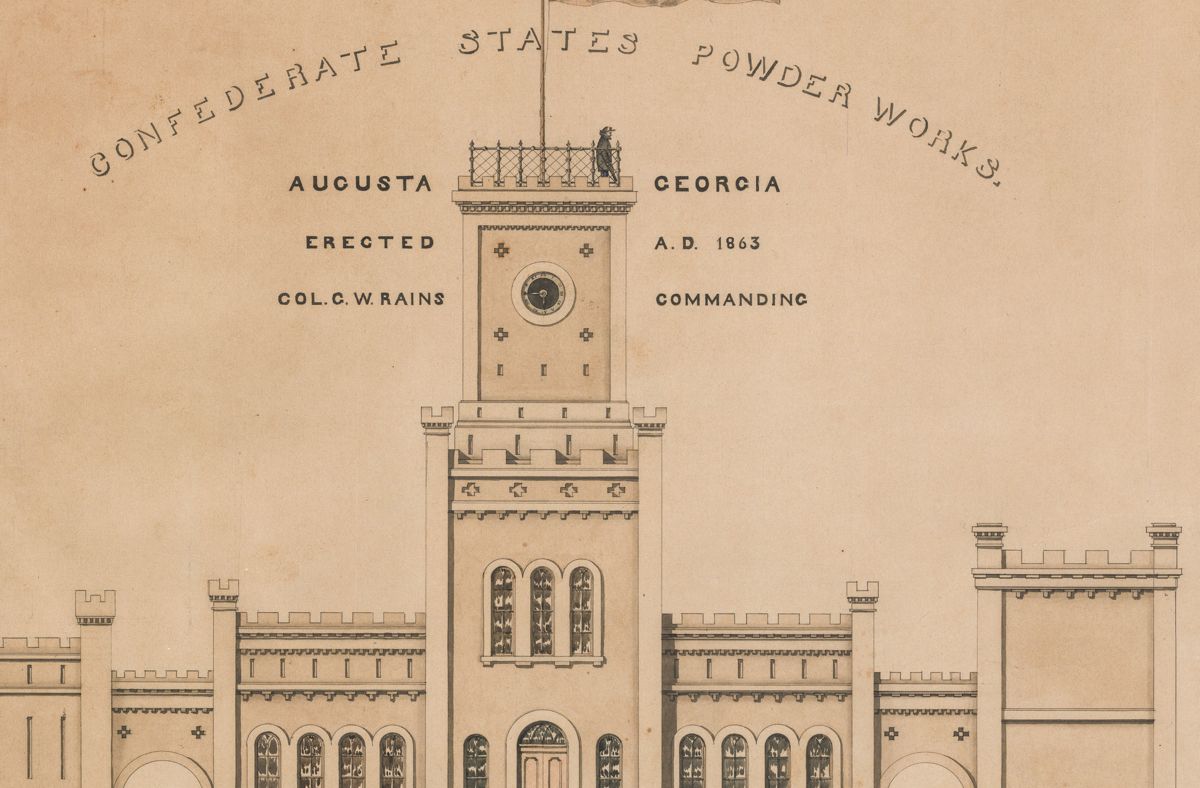
Confederate Powder Works, Augusta, Ga. (Courtesy of Augusta Museum of History)
pound was being made throughout its limits. To enter upon a great war without a supply of this essential material, and without effective means of procuring it from abroad, or manufacturing it at home, was appalling.” Rains uttered these frank words on April 26, 1882, in a speech to the Confederate Survivors’ Association in
Augusta, Ga. Rains was the man picked in 1861 to remedy the “appalling” situation. Augusta was the location of the Confederate Powder Works, a state-of-the art manufactory created mainly by this man’s genius. The men in the audience knew their guest speaker had succeeded in his challenging mission. On that Memorial Day, 16 years after the war, Rains told them how he did it. I will attempt to do the same for CWN readers. Rains set out from Richmond on July 10, 1861, to identify a site for the facility. He soon chose Augusta, as he stated, “for its central location; for its canal for transportation and water-power; for its railroad facilities; and for its security from attack.” He also surveyed the few privately owned powder mills that existed. These small facilities could not begin to meet the army’s needs. They did, however, serve as a stop-gap measure to meet immediate demands, while one also served, Rains said, as “a school of instruction for a few selected men, so as to have them ready for service at the Augusta Powder Works when they should commence operation.” Rains also labored to secure supplies of the raw materials needed to make gunpowder and planned the new facility in which these materials would be processed. As he traveled by rail he used the time to sketch out rough drawings for the complex of buildings to be erected along the Augusta Canal. Rains was aided in his plans by a pamphlet describing the operations of the Waltham Abbey gunpowder works in England. That the pamphlet lacked diagrams was a hindrance, but Rains was able to recruit a man who had worked at Waltham Abbey, a bit of luck which compensated somewhat for the booklet’s lack of pictures. These important finds made the situation somewhat less appalling, but the
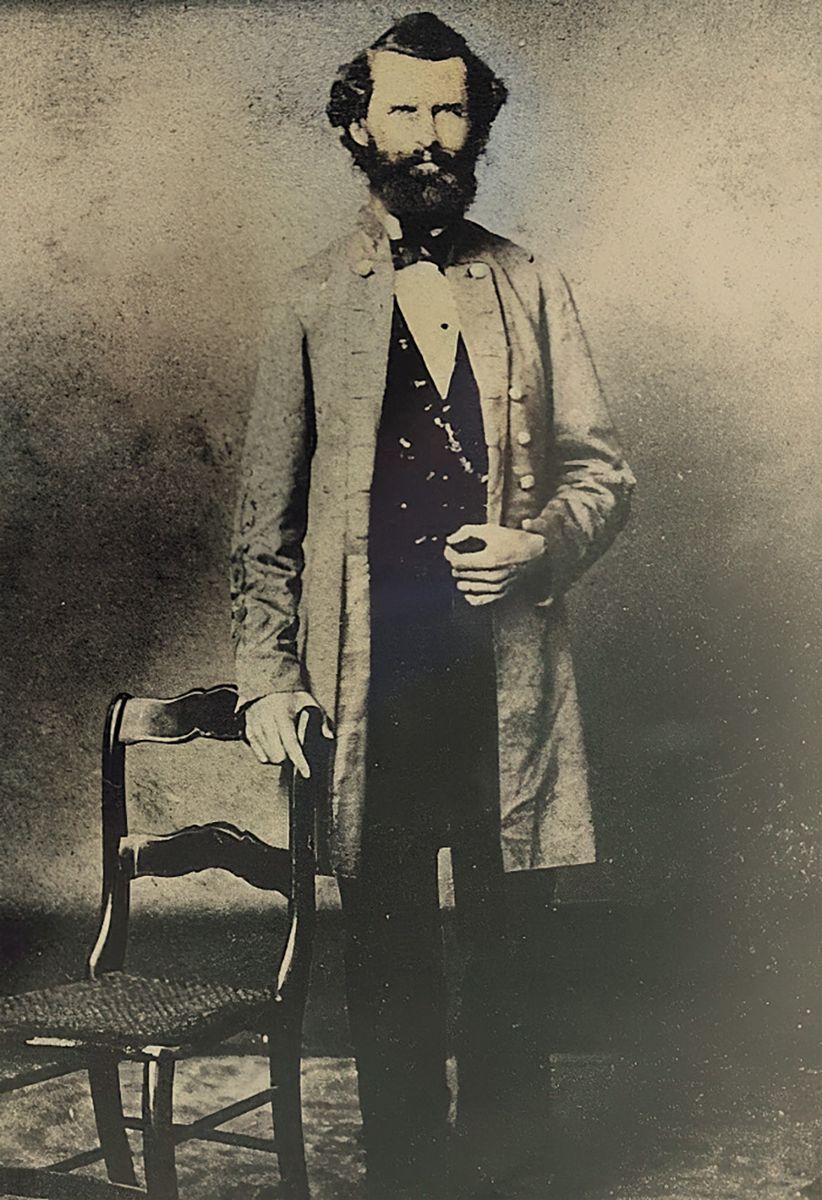
George Washington Rains.
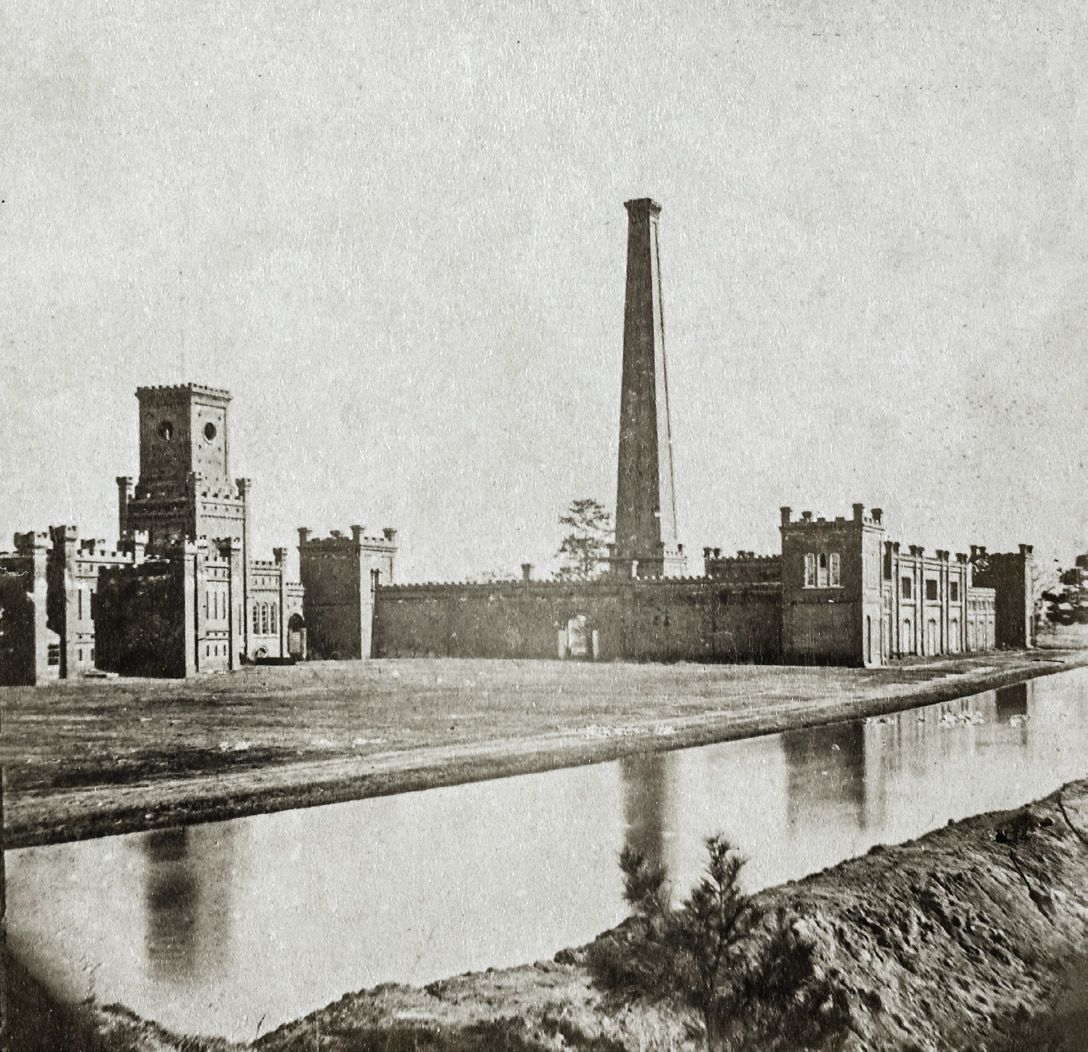
Confederate Powder Works, Augusta, Ga. (Library of Congress)
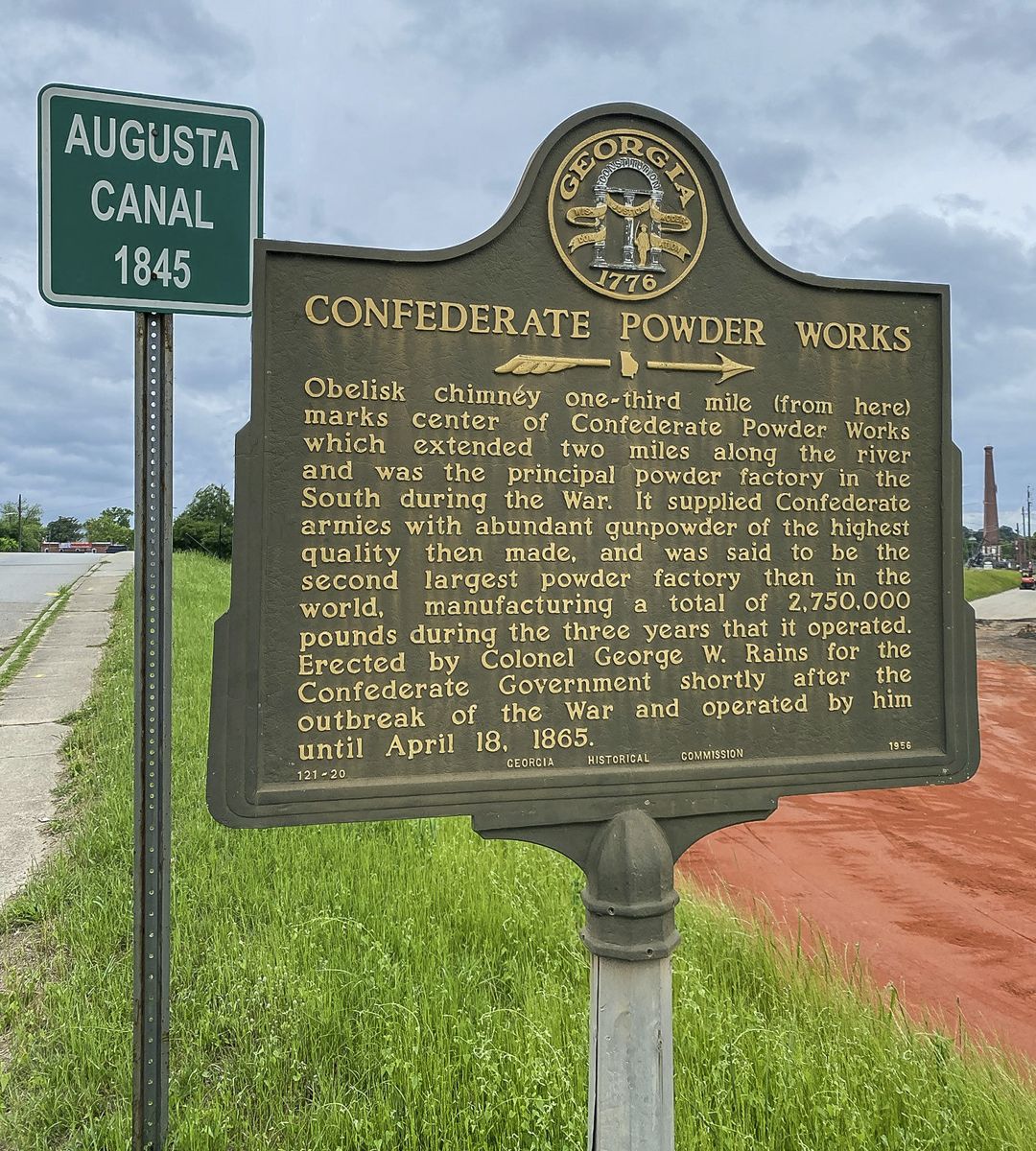
Georgia Historical Commission Marker Installed in 1956. (Photo by Gould B. Hagler II)
task ahead was still an immense challenge. Rains planned the operation and the various types of machinery and equipment needed and took steps to procure the necessities.
The Raw Materials
We’ll start with the things from which gunpowder is made. There are three ingredients: niter (or saltpeter), charcoal and sulfur. Nitrate of lime is found in the many limestone caves that are common in several Southern states. Early on Rains published a pamphlet to “provide the necessary information for their working.” He dispatched agents to assess the mines’ “capabilities and with authority to make contracts.” Later the government established a Nitre and Mining Bureau which had charge of the procurement of this vital material. Agents purchased supplies in Europe and shipped a total of 2,700,000 pounds of saltpeter through the blockade. Rains noted in his speech that the imports, plus 300,000 pounds supplied from the caves, “proved to be adequate to our wants.” Charcoal, made by the burning of wood in a low-oxygen environment, was less of a problem. Trees of the right kind, willow and cottonwood, were abundant. Rains had a sufficient supply of sulfur. Just before the shooting started the state of Georgia and some Louisiana sugar planters had received shipments from the North, totaling 300 tons or more. These supplies were turned over to the Confederate government.
&
The Machinery and Equipment
The making of good gunpowder is a complex process. To produce it in sufficient quantity Rains had to assemble a huge amount of heavy machinery and much other equipment. Rains procured the hardware from a wide variety of industrial facilities located throughout the eastern states of the Confederacy. It is interesting to note that the agricultural South possessed the ability to make all the things needed to transform the raw materials into gunpowder. The Tredegar Iron and Machine Works in Richmond made 10 iron beds and 20 rollers. These, plus two other sets from Macon and Chattanooga, weighed in total 240 tons. Chattanooga’s Webster Foundry and Iron Works were mainly responsible for a 300-foot-long cast iron shaft, along with “twelve heavy spur wheels2 and powerful friction arrangements to start and stop gradually each set of rollers.” An Atlanta manufactory cast a 16-foot gear wheel and a corresponding pinion to give motion to Webster’s shaft. Two hydraulic presses were made in Richmond. Twelve iron evaporating pans, holding 500 gallons each, were cast by a large iron works on the Cumberland River in Tennessee. Copper drying pans, 40 feet long and nine across, were made in Nashville. The Augusta Confederate Foundry supplied four cast iron retorts, eight cast iron coolers, and a dozen iron slip cylinders. Wilmington, N.C., contributed copper boilers, used originally as turpentine stills. From Charleston were shipped pumps, pipes, and cement. Savannah and Nashville were sources for sheet copper. For roofing, tin and
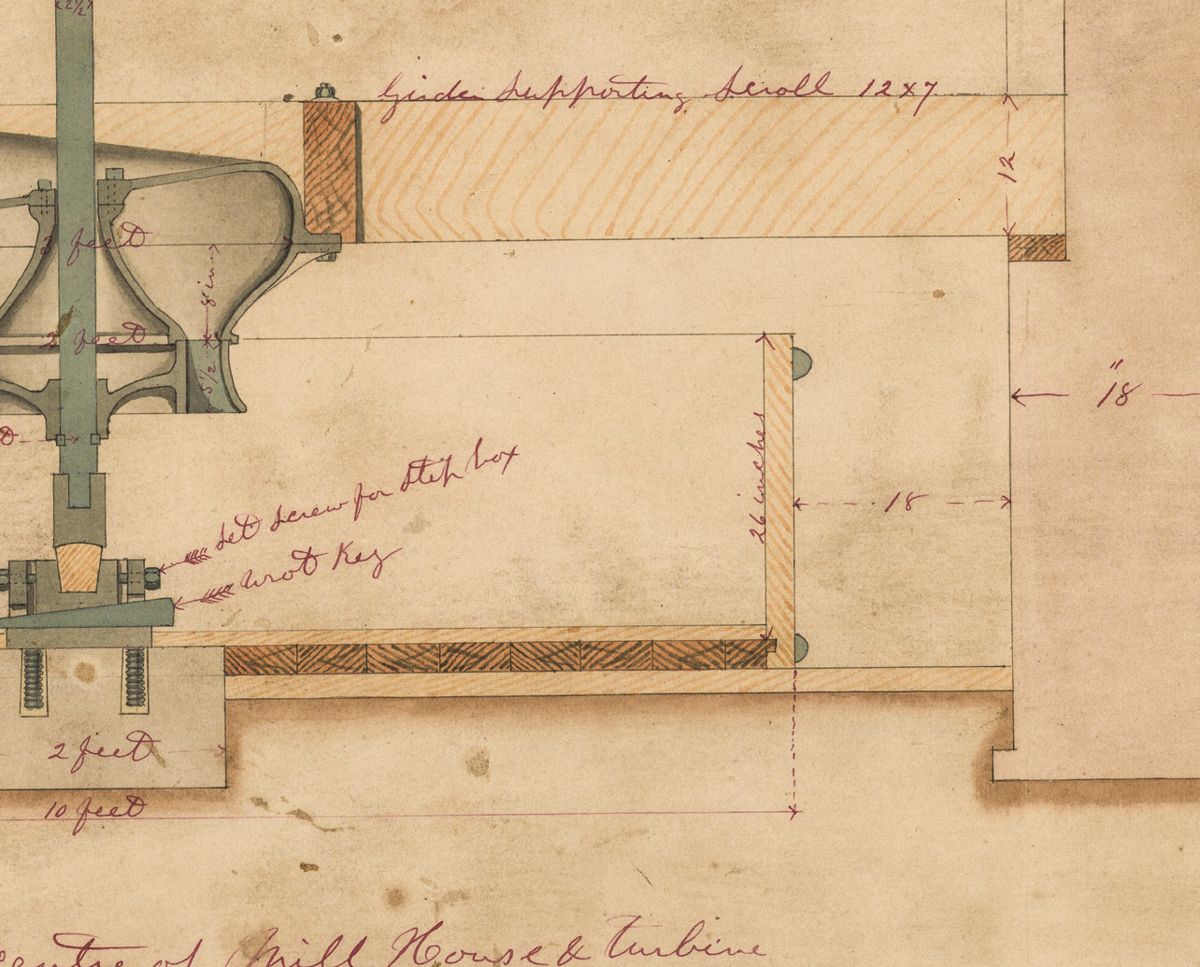
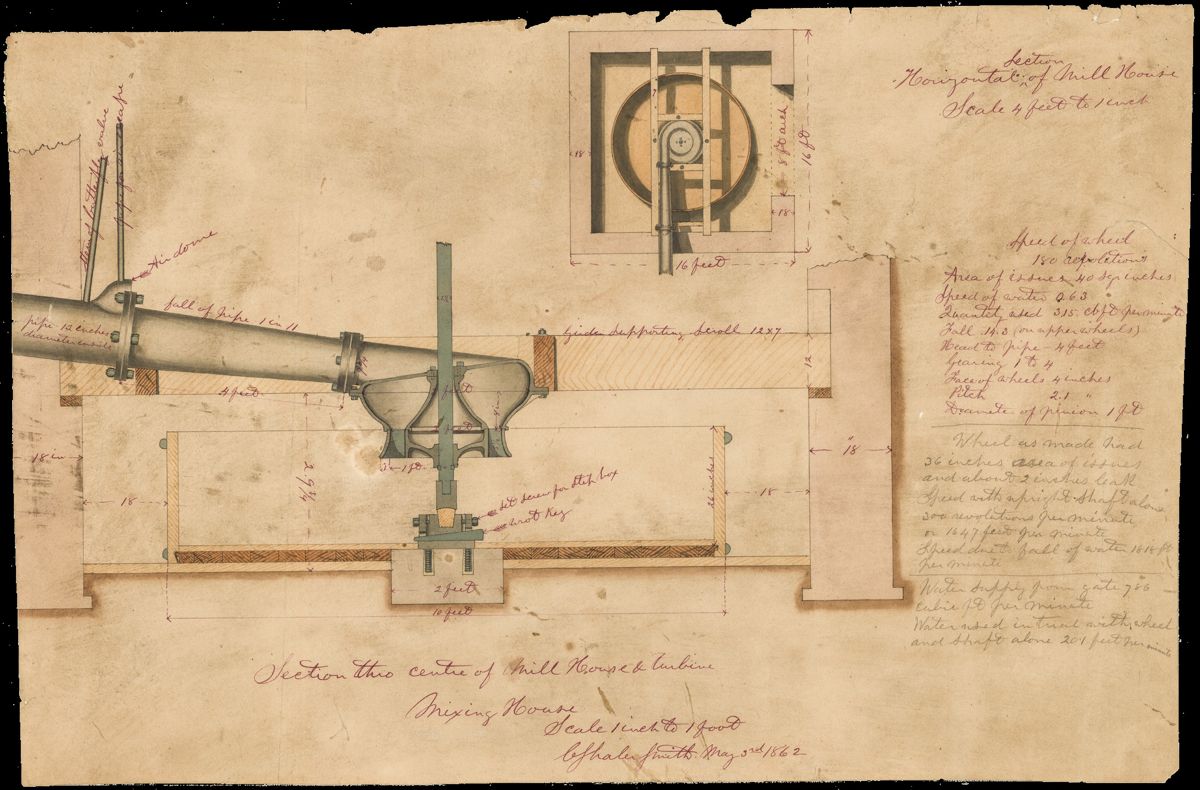
Section thro centre of Mill House and Turbine. (Courtesy of Augusta Museum of History)
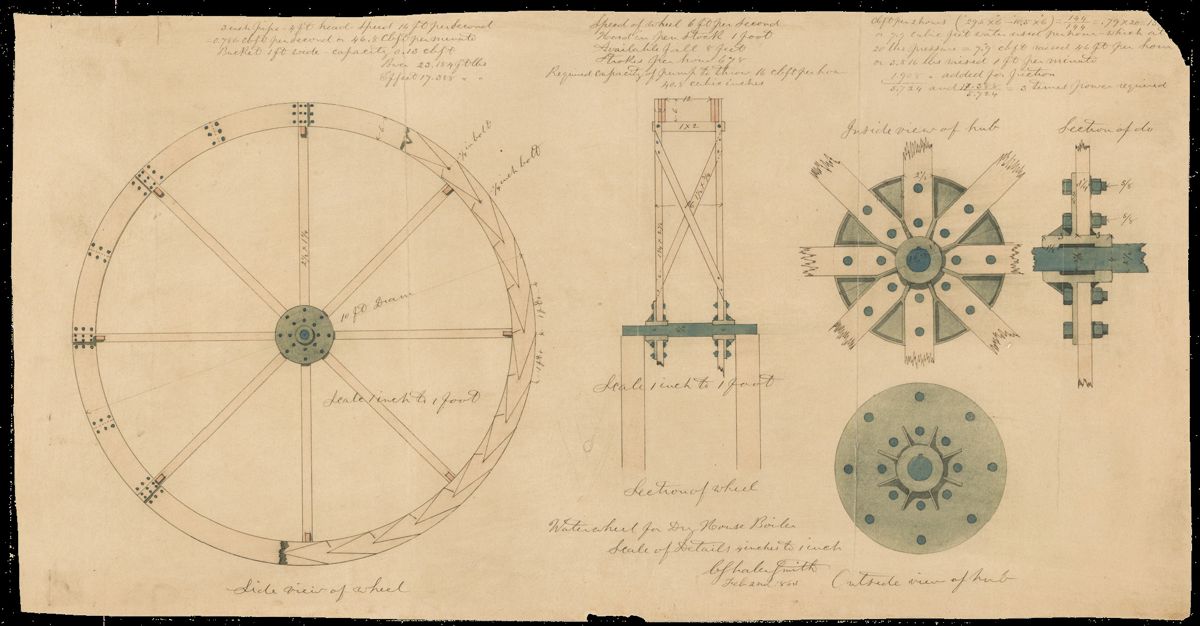
Waterwheel for Dry House Boiler. (Courtesy of Augusta Museum of History)
zinc came from Mobile. A foundry in Augusta cast the larger steam pipes, while New Orleans sent some smaller ones. North Georgia and Alabama were the sources for iron and coal, and copper came from Ducktown, Tenn. Two small steam engines were made in Macon and Selma. Not quite everything came from domestic sources. There was no “buy Confederate” mandate from the government. Rains said that “The fine steam engine of 130-horse power, having two cylinders and a fly wheel of fourteen tons weight, and five boilers was made at the North just before the war.”
The Buildings
As mentioned above, Rains used his time on the train to make rough drawings of his planned buildings for the Powder Works. C. Shaler Smith skillfully turned Rains’ sketches into detailed architectural plans. Two local builders took charge of the construction. The result was a functional
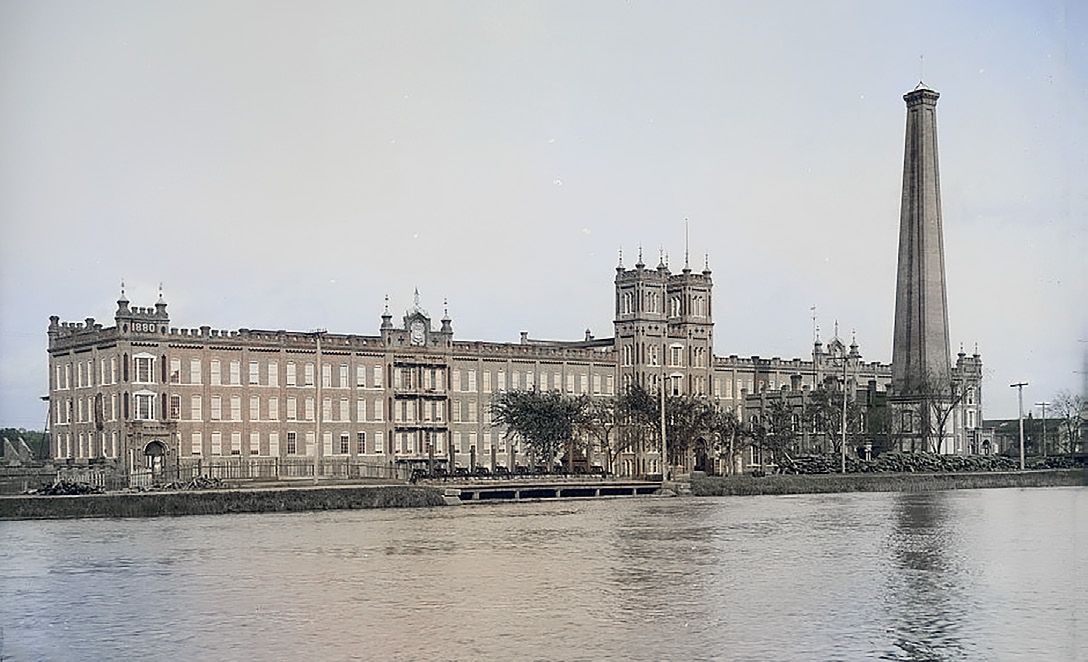
Sibley Mill ca. 1880 and Confederate Powder Works Chimney ca. 1862, located on the Augusta Canal at 1717 Goodrich St.
and elegant series of buildings, mostly of brick, which stretched for two miles along the Augusta Canal. The three ingredients entered as raw materials at the south end of the facility and exited from the north as high-quality gunpowder, stored in a magazine and ready to ship to the field. There were separate structures for the various processes: refining, pulverizing, mixing, incorporating, cooling, pressing, granulating, dusting, drying and glazing. The buildings were situated a safe distance from each other and stands of trees were left uncut to provide buffers. A railroad with oak tracks carried materials along this assembly line. The rail crossed the canal via a pontoon bridge. Material was also boated along and across the canal. In addition, there were storehouses, a stable, a blacksmith shop, a woodshed, a laboratory and, finally, the magazine to store the finished product. Of particular interest was the 296-foot-long building containing the dozen incorporating mills. The adjoining
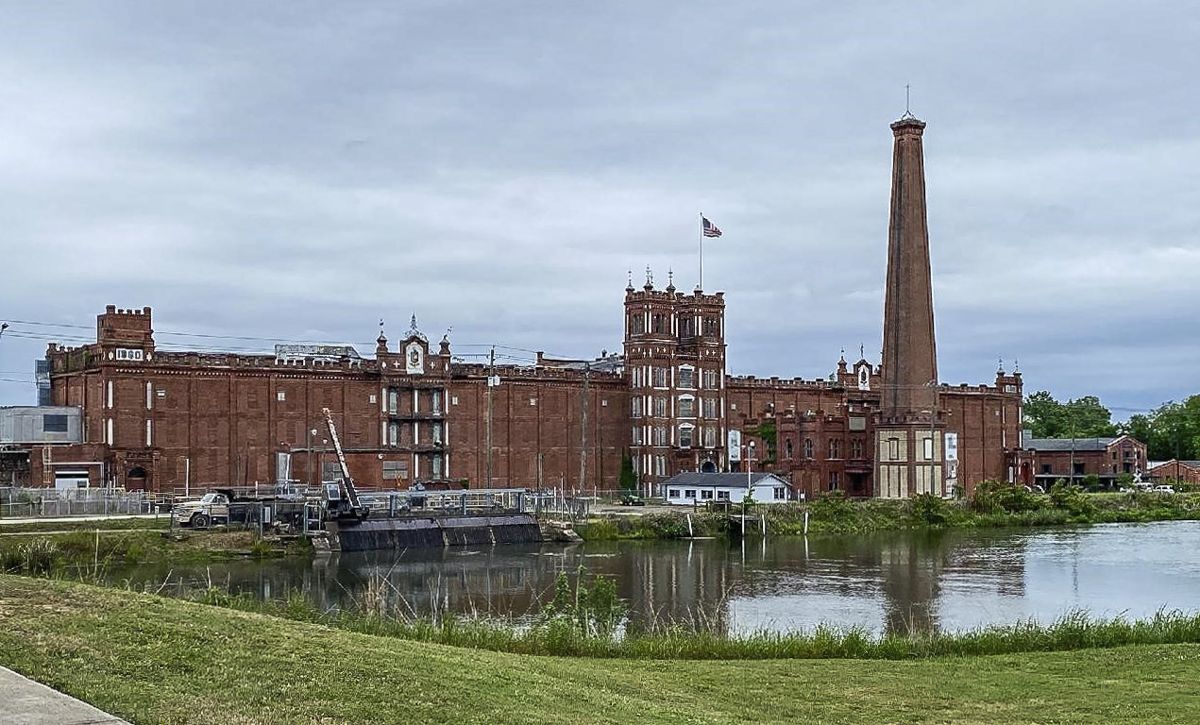
Today’s view of Powder Works Chimney and the repurposed Textile Mill. (Gould B. Hagler II, photo)
chambers, each 17 feet by 24 feet with a height of 28 feet, were laid out linearly, in two six-unit sets. Another brick chamber, the engine house, connected the two divisions. In this structure the mixed ingredients were pressed by large rollers. The chambers housing the machinery each had three massive walls of brick, four to ten feet thick. The fourth side of each was a light wall of wood and glass that would easily give way in the event of an explosion and direct the blast away from the structure. The light wall for each unit faced in the opposite direction from those of the adjacent units. The roofs were likewise light, made of sheet zinc. Rains began his work in September 1861, and the Augusta Powder Works were up and running three days after the second bloody day at Shiloh.
The Processing, Abridged Version
The three raw materials were refined and mixed into the proper proportions. The mixture was compressed, granulated and glazed. The finished gunpowder was then transported to the magazine, ready for shipment.
The Processing, Detailed Version
Refining At the lower end of the works, closest to the city, was the refinery. Here the niter, charcoal, and sulfur were processed. Regarding the niter, Rains stated that “to have its proper and enduring strength this constituent must be refined to almost chemical purity.” The crude niter was mixed with water and in a series of steps, which included boiling, draining, cooling, and raking, was rid of the impurities (chlorides, water, earth) and crystallized. The presence of chlorides causes gunpowder to absorb moisture, so removing this deleterious substance was of the utmost importance. In addition to being pure, the niter had to be refined quickly lest this step create a bottleneck. Rains devised a mechanized process which required only two or three workers and allowed for processing two or three batches daily. The Powder Works used about 5,000 pounds per day, according to the works’ records. In his 1882 speech Rains used the word “adequate,” not “plentiful,” to describe the supplies of niter available to the Powder Works. Great pains were taken to ensure that no niter was wasted. Any spilled was caught in tarpaulins or swept up. The vital mineral was recovered from any gunpowder that proved unusable. Spoiled gunpowder was shipped from the field to Augusta so that niter could be extracted and reused. Water for washing the workers’ clothes was filtered for niter residue. Nothing went to waste. The raw sulfur was purified by distillation in another section of the refinery. The unwanted acids were boiled away while the impurities (soil mainly) sunk to the bottom. The remaining vapor, now pure, was piped to another vessel and cooled into a solid. The third ingredient, charcoal, was made from plentiful local wood. Kiln-dried wood, split into slender sticks four feet in length, was packed into slip cylinders. These were in turn put into retorts, cylindrical in shape and slightly larger than the slip cylinders. The retorts, placed horizontally over a furnace, were luted with clay, providing the anaerobic environment in which the wood was charred. By using the
&
slip cylinders the operators could remove the charcoal when it was ready, and immediately insert another charged slip cylinder in its place, allowing for an uninterrupted process. Stored charcoal will absorb moisture, rendering it unsuitable for making gunpowder. Charcoal was therefore not stored, but used as it was produced.
Pulverizing
After the ingredients were refined, they had to be thoroughly broken up. Rains said the sulfur was “pulverized and bolted like flour.” First, the sulfur cakes were spread on an iron bed and crushed by “two iron wheels of twelve inches face and five feet in diameter.” The bolting was first done with silk screens. However, when these wore out and could not be replaced, Rains devised an alternative process. The pulverized sulfur was placed in barrels which slowly rotated on hollow, perforated axles. A light current of air blew through the axles and reduced the contents into “impalpable sulphur dust.” At first the niter, unlike the charcoal and sulfur, was thought to be fine enough not to need pulverizing, but later, it too was further crushed in ball mills.
Mixing
After the ingredients were separately refined and pulverized, they were hauled to the mixing house. There they were combined in the correct proportions, by weight 75% niter, 15% charcoal and 10% sulfur. Charges (varying from 60 to 80 pounds) were mixed in rapidly rotating ball mills. Rains stated that to produce the desired quality of gunpowder, it was necessary to “achieve the most perfect mixture possible” between the charcoal and the niter. After some experimentation, Rains began to moisten the material with steam. This treatment ensured that the niter “would speedily penetrate the minute pores of the charcoal.” On cooling the mixture became a damp cake, ready for the next step.
Incorporating
In this step the cooled mixture was pressed under fiveton rollers in the incorporating mills. These rollers rotated ten times per minute on iron beds seven feet in diameter. According to Rains, the steaming, performed in mixing, reduced the processing time from four hours to one. “The capacity of the work of the mills was thus practically quadrupled,” Rains recalled in 1882.3 The heavy rollers compressed the mill cake to a thickness of about fiveeighths of an inch. To add another safety feature to the design of the building, as explained above, a fire suppression system was installed to contain any explosions that might occur at this dangerous stage of the process. In each of the dozen incorporating mills, a 30-gallon water-filled vessel was balanced above the rollers. In each of the two six-mill divisions, a single shaft connected all the vessels. “Thus, on an explosion in one mill,” Rains explained, “its bed-plate was instantly drenched with water, and this caused the same to take place at the same moment with all the others.” Rains reported that there were three explosions in the incorporating mills. In each case the damage was minor.
The design of the building minimized the damage to the structure, and except for the drenching, no damage was done to any mills other than the one in which each accident occurred. Two workers were slightly injured in one of the three explosions.
Cooling
After the rollers had done their work, the mill cake was transported across the canal (via the oaken rail line and its pontoon bridge) to the cooling magazines. This building contained four ten-foot by ten-foot chambers, dug into the earth. After cooling, the mill cake, now cold and hard, was ready for the last few steps.
Pressing
In this operation the cooled mill cake was crushed into a fine powder. A hydraulic press was then employed to pack the powder into dense, thin cakes. This compacting minimized the dust that would be present in the next stage of the operation and made the final product less susceptible to absorbing moisture. It also made the gunpowder more powerful, as it would produce more gas per a given volume.4
Granulating
The machinery in the granulating house consisted of two pairs of rollers and equipment to separate the grains according to size. The pressed cake was first dropped between a pair of bronze-toothed cylinders then through a pair of smooth ones. Vibrating screens then separated the larger grains (for artillery) from the smaller grains (for small arms). The original granulating house was made of wood and was destroyed when three tons of powder exploded. This explosion, which took the lives of nine men, was the only serious accident to occur at the Powder Works. The permanent building going up nearby was nearly finished and was only slightly damaged.
Drying, Dusting and Glazing
The last three steps were combined into a single process designed by Rains. The work was carried out 2,500 feet up the canal from the refinery. In his address Rains explained that the powder was “placed in revolving cylinders having hollow axles, and a current of air warmed by passing through an arrangement of steam pipes was blown through, carrying the dust into its receptacle, leaving the grains clear. This also dried and glazed them at the same time.” Blown by the warm air, the unwanted dust was wafted away and the grains were dried. It is not clear, from Rains’ description, how the dust was carried from the cylinders into the receptacles. At Waltham Abbey, the cylinders used for drying were made of canvas, so the dust was spun off through the canvas into a box which surrounded the cylinder, while the grains remained inside. Rains’ process must have been something similar. The glazing, or polishing, was accomplished simply by the action of the tumbling grains colliding repeatedly as the cylinder rotated. This polishing hardened the surface of the grains, making them more impervious to moisture.
Ready for Use
The niter, charcoal and sulfur were now transformed into gunpowder of the highest quality. The finished powder was taken to the magazine, located up the canal two miles from the refinery where the processing began. From there it was shipped to the armies fighting for the Confederacy’s independence.
The Final Months and the Aftermath
After the fall of Atlanta, Pres. Jefferson Davis embarked on a morale-building tour of the Western Theater. In October he visited Augusta and delivered a speech in which he predicted victory, expressing great confidence that the people’s “energy, harmony and determination would rid the country of its enemy.” Davis highlighted Augusta’s contribution. “This city of Augusta alone,” Davis said, “produces more powder than the army can burn.”5 The energy, harmony and determination notwithstanding, the Confederacy was in fact close to the end of its tether, but the task of the Confederate Powder Works was not yet done. When Sherman’s force left Atlanta on November 14, 1864, its destination was unknown. Augusta, with the Powder Works and other important manufactories, was a likely target. As the Federal army began its march, Rains ordered that key machinery be disassembled and shipped to Columbia, along with the finished powder in the magazine. Before the equipment reached the South Carolina capital, however, it became clear that Sherman was bound for the coast. Rains recalled the shipment and re-installed the machinery. By the time Sherman reached Savannah the Powder Works were back in business. Production continued until April 18, 1865. In its 36 months of operation the works shipped 3,376,123.2 pounds of powder, approximately two-thirds of which was destined to be used by artillerymen and one-third by their comrades carrying rifle muskets. At the conclusion of the Civil War all property of the Confederate government was taken over by the United States. In 1882 the government deeded the Powder Works property to the City of Augusta. That same year the chimney was dedicated as a memorial to the Confederacy. All the structures except the chimney were eventually demolished. A textile mill was built in 1882, partly with brick from the dismantled Powder Works. Under various owners the mill operated until 2006. The property is now owned by the Augusta Canal Authority. In 2020 the property was leased to a company that is developing it for commercial and residential use. The textile buildings will be renovated and repurposed. The memorial chimney will remain. General Rains remained in Augusta and became an educator, teaching chemistry at the Medical College of Georgia. He retired in 1894 and moved to Newburgh, N.Y., his wife’s original home, where he had once been the proprietor of an iron works. Rains died in 1894 at the age of 81.
Glossary
Ball mill – A pulverizing machine, consisting of a rotating drum containing metal balls, used to break up materials in industrial processes.
Bolt – To run broken material through a sieve or a similar device to separate the larger and smaller pieces. Glaze – In gunpowder manufacturing the term means polishing and hardening of the granules to make the product more resistant to atmospheric moisture. Lute – A substance, such as clay, used to seal joints and coat porous surfaces. Pinion – A small gear that meshes with a larger one. Retort – A closed vessel in which materials are heated to high temperatures. Slip cylinder – In modern usage the term refers to a device to control a sliding motion between two parts of a machine. As used by Rains, the term means a cylinder that fits inside another cylinder for the efficient transfer of wood into, and the charred wood out of, the charcoal furnace. Spur wheel – A gear parallel to the axis of rotation used to transfer power between parallel shafts. Sources: Rains’ 1882 speech was published as History of the Confederate Powder Works by the Newburgh Daily News Print in Newburgh, N.Y. It can be ordered from Kindle and is free of charge. Never for Want of Powder: The Confederate Powder Works in Augusta, Georgia by
C.L. Bragg, Charles D. Ross, Gordon A. Blaker, Stephanie A.T. Jacobe, and Theodore P. Savas is a detailed history of the Powder Works. Three chapters by Charles Ross contain excellent descriptions of the production process.
Endnotes 1. Rains was promoted to colonel on July 12, 1863. In the Confederacy’s last days, officialdom may have taken steps to commission him as brigadier general. Years later Rains stated that he had been informed that this was the case. He also said that he never received the commission. He is often referred to as General Rains. 2. Terms that first appear in italics are to be found in the glossary. 3. Rains made this statement in his 1882 speech. In Never for Want of Powder, Charles Ross questioned whether Rains’ memory was correct on this point. Productivity was certainly improved, Ross wrote, but not to that extent. 4. In his speech Rains said that this step was usually skipped, being unnecessary after the incorporation under the six-ton rollers. After cooling, further processing was not needed, Rains said, and the mill cake was reading for dusting, drying and granulating. However, according to Ross, Rains was mistaken on this point, saying that the pressing step was included in the Ordnance Manual for Use of Officers in the Confederate States Army and was usually included at the Augusta works. 5. Richmond Daily Dispatch, October 10, 1864.
Gould Hagler is a retired lobbyist living in Dunwoody, Ga. He has been a regular contributor to CWN since 2016. He can be reached at gould. [email protected].
ACE p yro llc
Black Powder
Subscribe and join our thousands of readers at https://tinyurl.com/277vpke9
Speakers & Panelists will include Allen C. Guelzo, Gary W. Gallagher, Joan Waugh, William C. Davis, Alan Taylor, James Oakes, Harold Holzer, Jonathan W. White, Edna Greene Medford, Jon Grinspan, Frank J. Williams, AND MORE! VISIT WWW.THELINCOLNFORUM.ORG FOR A COMPLETE SYMPOSIUM SCHEDULE
REGISTRATION IS OPEN TO ACTIVE FORUM MEMBERS ONLY—JOIN ONLINE TODAY!